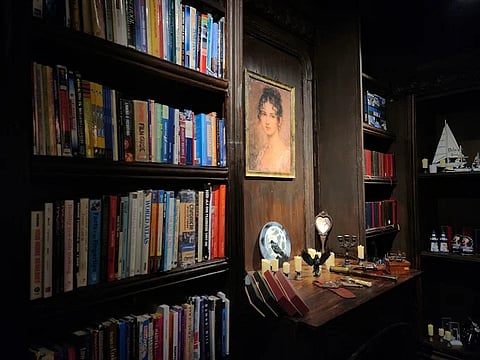

When the famous Khader Nawaz Khan (KNK) Road reopened this February after a revamp, one of the first things that caught Chennaiites’ eye was Moore Market, not the historic marketplace in Broadway for second-hand books and rare antiques, but something more contemporary. At this café-bookstore, books spill across towering shelves, gothic and vintage collectables fill every corner possible, and ornate décor compete for attention. At a time when muted interiors dominate cafés and hangout spaces dominate the scapes, Moore Market is unapologetic about its existence. It is, perhaps, one of Chennai’s odes to maximalism.
But does maximalism only belong to architecture? Once dismissed as ‘too much’ and ‘excessive’, it is now increasingly being embraced as a way of expressing identity, celebrating nostalgia, and moving past ‘clean’ aesthetics through layered jewellery and statement fashion to bold beauty looks, genre-blending playlists, and visually dense social media feeds.
Ashvin E Rajagopalan, founder of Ashvita’s and director of Piramal Art Foundation, states that the idea of maximalism isn’t new to India at all. “India as a whole is maximal. We have the biggest traffic jams, we have the largest number of people, every single temple, architecture, nook and corner is maximal. You can’t look at the Brihadeshwara temple and say that’s minimalistic,” he says.
Ashvin believes the current conversation is less about India discovering maximalism and more about rediscovering something that has always existed. He also notes that India is witnessing another aspirational phase similar to “the dot-com boom between 2000 and 2008 where generational wealth changed hands, people made money, art changed, and trends changed.” He adds that today, 20 years later, it has been fuelled again by heightened brand awareness and social media.

When it comes to fashion and everyday aesthetics, the revival is evident. “People are no longer buying silver just for special occasions. They’re choosing bold pieces that reflect their personality. Silver has become a medium for self-expression, both in jewellery and home décor. There are fewer rules and a lot more individuality,” says Aryant Bafna, founder of The Silver Co. “In silver, it (maximalism) means bold silhouettes, intricate detailing, and designs that instantly draw attention. A maximalist piece has presence without compromising on craftsmanship,” he adds.
That confidence is particularly evident among younger buyers. “They’re buying it for themselves, styling it daily, and using it to express their taste. Instead of inheriting silver, they’re building collections of their own,” he says. Aryant adds that layered jewellery, bold cuffs, statement rings, sculptural décor, and personalised pieces are seeing increased demand. In home décor, silver-plated statement pieces like clocks, frames, and even furniture are gaining attention as people look to make their homes feel more expressive.
Brands & social media
This shift to maximalism in branding and advertising, according to Pooja Palla, brand creative strategist at MediaWithPJ, has become a response to an increasingly AI-generated virtual landscape. “Right now, everything has become AI-perfect and polished. The only way brands can stand out is by going back to maximalism, handmade architecture, and authenticity,” she says. Pointing to brands like Project Qaafi, Subko Coffee Roasters, Pistabarfi, and Gullylabs who are embracing expressive typography, layered graphics, handcrafted illustrations, and culturally-rooted storytelling, she says, “People are saturated with minimalism. They want to bring back culture and maximalism, either through packaging or advertisements.”
Closer home, Pooja argues that Chennai has always embodied this aesthetic. “We’re already maximal when it comes to our jewellery and even the outfits we pick. Everything seems to be maximal normally itself. Even wearing a bindi is maximal for us.” Talking from her own experience of working with a brand, she adds, “They ripped off our Indian temple jewellery and shipped it to the US, and they quoted it as desi girl maximalism or desi IT girl. That is how I understood that we as South Indians are already maximal.”
Pooja also refers to the recent Paris Haute Couture Week, where Rahul Mishra’s ‘Devi’ transformed ancient Indian temple sculptures into sculptural couture, finding global expression of the maximalist aesthetic. Beyond aesthetics, experts believe the movement is deeply personal. “When people wear colours they personally enjoy, it improves self-expression and confidence,” says clinical psychologist Dr Ashima Srivastava.
Yet, maximalism is not without criticism. One of the biggest criticisms is that it encourages overconsumption. But many creatives argue that maximalism can also exist alongside sustainability and reuse. Delhi-based Xitija runs Tukura Tukuri, a brand that creates fashion accessories, mixed-media artworks, and apparel using discarded materials, scrap objects, old fabrics, and thrifted finds. A maximalist herself, Xitija enjoys layering outfits and experimenting with colours. “I love pulling together things that would not go together,” she says. “There’s a kind of agency in dressing that way. The layers feel very protective.” Her approach to maximalism shows that the aesthetic does not have to rely on expensive, high-end luxury. Instead, it can be achieved through thoughtful curation, creativity, and design sensibility.
(Inputs by Pankil Jhajhria)