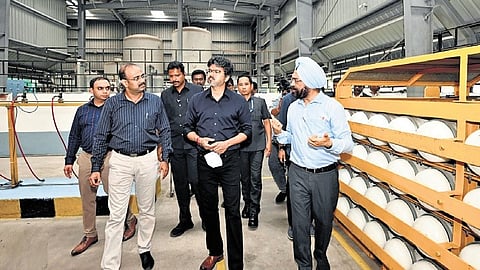

CHENNAI: Chief Minister C Joseph Vijay on Monday directed the Greater Chennai Corporation (GCC) officials to ensure that the city’s entire daily municipal solid waste is scientifically processed through source segregation, conversion of biodegradable waste into bio-CNG and organic manure. He also directed utilisation of non-biodegradable waste for road construction and as refuse-derived fuel in cement industries.
The CM issued the directive during an inspection of the bio-CNG plant at Chetpet, which is being operated under a public-private partnership (PPP) model on behalf of GCC. During the visit, Vijay reviewed the entire process of converting biodegradable waste into compressed bio-CNG through anaerobic digestion. He also instructed officials to replicate the model across all urban local bodies in Tamil Nadu within a stipulated time frame.
The Chetpet facility processes 120-140 metric tonnes (MT) of segregated wet waste every day against its installed capacity of 140 MT. At full capacity, the plant can produce around 4,900 kg of bio-CNG daily, which is purified, compressed and supplied to hotels, restaurants, commercial establishments and fuel stations.
A similar bio-CNG plant at Madhavaram, with a capacity of 180 MT per day, currently processes 160-180 MT of wet waste. Chennai generates about 6,150 MT of municipal solid waste every day, including nearly 3,200 MT of biodegradable waste.
While the civic body earlier processed most wet waste into compost using the windrow method, it has now increasingly adopted bio-CNG technology, reducing landfill dependency and improving environmental outcomes.
To expand processing capacity, the GCC is establishing five additional bio-CNG plants with a combined capacity of 500 MT per day.
