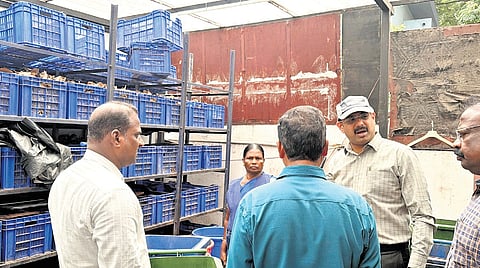

CHENNAI: The city corporation has designated 100 nodal officers, including IAS-level officials, to closely monitor compliance by the top 250 bulk waste generators (BWGs), from across all 15 zones, with mandatory source segregation and biodegradable waste processing within their premises. The 250 are among the 3,204 BWGs identified across Chennai through a field survey.
Speaking to TNIE, Greater Chennai Corporation (GCC) Commissioner GS Sameeran said the civic body has decided to provide bulk waste generators with a grace period of one month to ensure source segregation and on-site processing of wet waste.
“Each nodal officer has been assigned a specific BWG for regular monitoring and is tasked with submitting periodic compliance reports. Based on these reports, penal action will be initiated against establishments that continue to violate the rules after the grace period,” Sameeran said, adding that similar enforcement measures would subsequently be extended to households.
The GCC, spread across 15 zones and 200 wards, generates around 6,150 tonnes of municipal solid waste every day. Under the Solid Waste Management Rules, 2026, BWGs are required to register on the centralised online portal, segregate waste into four categories (wet, dry, sanitary, special-care or hazardous waste), and process biodegradable waste within their premises wherever applicable. Failure to comply attracts penal action, including environmental compensation.
According to a circular issued by Sameeran on July 6, nodal officers will conduct regular inspections and upload photographs twice a week, along with details on the establishment, placement of colour-coded bins, source segregation and the quantity of wet and dry waste generated, on a dedicated WhatsApp group for continuous monitoring.
The commissioner has also instructed officials to ensure registration of all eligible BWGs on the centralised solid waste management portal. IAS officers designated as nodal officers include Regional Deputy Commissioner (Central) HR Koushik, Joint Commissioner (Health) Shreya P Singh and Regional Deputy Commissioner (South) Aftab Rasool. Of the 3,204 BWGs in GCC limits, 2,743 (86%) have registered on the GCC portal, compared to only 514 registered so far on the Central Pollution Control Board (CPCB) portal.
Teynampet has the highest number of identified BWGs at 526, followed by Kodambakkam (411), Adyar (317), Madhavaram (253) and Perungudi (245). Adyar has achieved 100% registration, while Manali has registered 211 of its 212 identified BWGs. Anna Nagar has recorded 82 registrations despite only 77 BWGs identified during the field survey.
Among the city’s largest BWGs are DLF Town Down (4,000 kg of waste generated daily), Brigade Aspiro Apartments (3,600 kg), Baashyaam Apartments (2,800 kg), Phoenix Marketcity (2,500 kg), Casa Grande Apartments, Hotel Savera, CapitaLand Ascendas, Four Points Hotel and ITC Grand Chola, each generating around 2,000 kg of waste daily.
The GCC has already collected `25.95 lakh in penalties this year.
GCC chief meets World Bank delegation
Chennai: Corporation commissioner GS Sameeran on Thursday held discussions with a high-level World Bank Group delegation on implementing projects in the city with World Bank financial assistance.
A major focus was placed on enhancing climate resilience by developing robust strategies for integrated flood and rescue management, as well as implementing urban heat mitigation measures such as cool-roof solutions to reduce the urban heat island effect across corporation buildings.
To promote clean energy and sustainable mobility, the proposals included establishing a network of electric vehicle (EV) charging stations at strategic locations across the city and installing rooftop solar panels on administrative buildings and corporation schools. The meeting also explored measures to upgrade healthcare facilities and strategies to enhance the civic body’s revenue generation.
