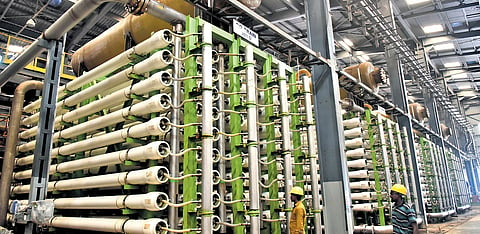

CHENNAI: An unusual jellyfish bloom off Nemmeli coast disrupted production at the two desalination plants last week, affecting water supply to several parts of south Chennai. The Chennai Metropolitan Water Supply and Sewerage Board (Metro Water) has now roped in IIT Madras and the National Institute of Ocean Technology (NIOT) to study the phenomenon and prevent similar disruptions in future.
According to sources, jellyfish entered and clogged the pipelines that draw seawater into the desalination plants despite protective systems to keep marine life out. “Such an incident occurred last week, reducing production at the plants for two days,” sources said.
The Metro Water usually runs into the jellyfish trouble every year or two. What made last week worse was that the jellyfish were bigger than those seen during previous blooms. The desalination plants also had its usual issues around the same time, including power shutdowns and damaged distribution pipelines.
The 150 MLD plant has been operating at roughly half its capacity for the past two weeks, while the 110 MLD plant has managed around 60%. Output levels were at its lowest on July 18, when the 150 MLD plant produced just 21 MLD and the 110 MLD plant 59 MLD of water.
A Metro Water official said the jellyfish issue has since cleared up and the plants are currently meeting drinking water demand, adding that the ongoing study is meant to help handle future blooms better. Experts from IIT-M and NIOT have collected jellyfish samples and are studying what could be driving the spike near the plants.
Meanwhile, Metro Water has also responded to a TNIE report published on July 24 on the water shortage in Velachery. It said the Adyar zone, allocated 93.5 MLD from the desalination plants, received only 84.8 MLD on July 23, a 24 MLD shortfall over the last two weeks which cut piped supply to tail-end areas. “Alternate arrangements are being made to improve the supply,” Metro Water said.
