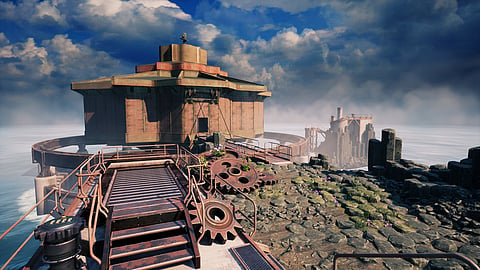

For as long as I have known my partner, he has been telling me to try Myst. It’s a game he only half remembers from when he was a child. And it isn’t just him. Many gamers might have heard of Myst, which is widely regarded as one of the best puzzle games to exist, and a foundational one at that. But why am I now playing a game that was released in 1993? Well, as of May this year, VR and PS5 users can play the remastered version of Myst for the very first time. The question is, does it still hold up? Is it worth playing this remastered version, or does all of Myst’s value lie in the nostalgia?
Here’s the set up: you are a person dropped into Myst island. A place that is created entirely by the imagination of another man. Spread across the island are a myriad of confusing constructions. There’s a library, but most of the books are burnt. There’s a watchtower, a clock tower in the middle of the water, a half sunken ship, a tiny rocket, and even an astronomical observatory. All of these seem only partially functional. The game gives you very little information on what these structures mean, let alone what they are meant to unlock. One thing you may realise across the game is also the idea of “linking books” — which transports you somewhere completely different, out of this original island, to different islands rendered from alternate versions of reality. There’s information to get from each of these islands and you need to play to find out.
There’s probably enough and more video essays that say this better, but Myst’s greatest success is in having a puzzle game that is almost completely driven by a very convoluted nest of environmental clues. And each one of them gives away very little. Which means that you must slowly form these connections and recreate the webbed lines of this nest in your head, till eventually, it all makes sense.
Reader, I’m finding it a bit difficult to explain the puzzles because I really do not want to give an example of any actually existing puzzles in the game. It’s incredibly satisfying to figure it out by yourself and I don’t want to ruin things if you are to attempt the game. But the essence of a Myst style puzzle is simply to really observe your surroundings and connect things from different places. A statue on one end of the island could be a potential clue to something on the other end of it. The art in the game is the stuff of dreams; there’s something inexplicably magical about these islands and they truly feel like worlds you’d want to explore. Channelwood (name of an island) in specific, was my favourite. If it isn’t clear already, I loved this game.
Having tried Myst’s non-remastered version as well, I have some big thoughts. The original game of Myst from back in the day, was basically the equivalent of a powerpoint presentation with multiple ‘if’ and ‘while’ loops creating sequences of events. Basically, a point and click game with multiple images stitched together, and no real 360 degree views, or turning around and walking about in the way modern games work. So essentially, you looked at every single frame of the game as a potential clue. In a way, this would make you pay attention more clearly to every single frame. But it also did add a lot of unnecessary friction to a good puzzle game. The remastered version does dilute the original experience a little by removing the laborious process of clicking each frame to get from point A to point B. While it doesn’t fundamentally make the solving of the puzzles a whole lot easier, I wonder if this is a good thing? I’m very sure that the nostalgia is corrupting my view of the game a bit, but isn’t the additional labour a part of the joy of solving the puzzle itself? I’ll let you answer this for yourself once you try it out.
Long story short, Myst does very much hold up. If you’re someone who enjoys a good puzzle game, there’s really no question here. Buy it. Myst easily qualifies in the league of games like Return of the Obra Dinn, and Lorelai and the Laser Eyes. In fact, I would argue it’s even slightly influenced the development of these newer games. Even the developer of Blue Prince — a big hit from a few years back, gave credit to Myst for inspiring the structure of the puzzles within it. If you’ve been thinking about it for a while, I would highly recommend trying out the remastered version of Myst, and then if you liked it, moving on to Riven after that (which is apparently, a lot more difficult).
