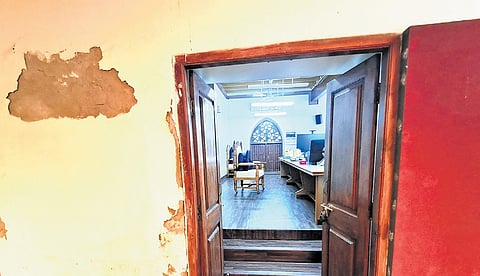

CHENNAI: The southern bench of the National Green Tribunal (NGT), the country’s premier environmental court entrusted with deciding some of South India’s most significant ecological disputes, is functioning from a building with collapsing roofs, termite-infested wooden structures, peeling wall paint and damaged toilets raising concerns over the safety of judges, lawyers, litigants and staff. TNIE visited the 245-year-old Kalas Mahal, where the tribunal has been functioning since 2017, and found alarming signs of structural deterioration.
Chunks of concrete have fallen from ceilings, wooden beams and door frames have been extensively damaged by termites, plaster is peeling across several walls, and both restrooms are in a dilapidated condition, with one western toilet having collapsed into pieces after concrete from roof fell on it.
The irony is difficult to miss. The very institution hearing cases on environmental governance and public safety is operating under conditions that lawyers describe as hazardous.
According to officials, the Public Works Department (PWD) itself had, a few years ago, identified parts of the heritage structure as unsafe and requiring urgent repairs. Wooden pillars in several locations were marked as termite affected, but comprehensive restoration has not been undertaken.
Inside Court Hall number 2, the raised platform used by the Bench has begun caving in because of termite damage beneath the wooden flooring. The conference room, meant for official meetings, has become unusable for video conferencing because of safety concerns, forcing officials to vacate the space.
Advocate S Poiyamozhi said the deterioration has reached a stage where lawyers and litigants fear for their safety every day. “Court Halls 2 and 3 are in a very bad condition. Both the men’s and women’s restrooms have deteriorated. We are using the men’s restroom in the Women’s Commission office on the first floor. We are attending court with constant concern that something may fall from the roof or walls,” he said.
When contacted, a senior PWD official attributed much of the deterioration to moisture-related issues common in heritage structures. “This is a composite heritage building where dampness occurs because of capillary action, causing moisture to travel through the masonry. Air-conditioning in old, naturally ventilated buildings can also lead to moisture entrapment if not properly managed. We are planning to call for tenders for repair works,” the official said.
Kalas Mahal, part of the historic Chepauk Palace built in 1768 by Nawab Mohammed Ali Wallajah, is recognised as one of India’s earliest Indo-Saracenic structures. After being ravaged by a major fire in January 2012, the building underwent restoration before the NGT shifted there in September 2017. The NGT, in a letter dated July 16, formally wrote to the chief secretary detailing the deteriorating condition of the premises and the urgent need for intervention.
