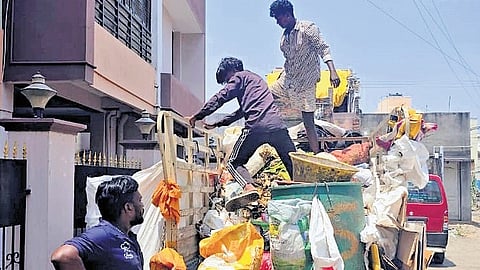

CHENNAI: A section of conservancy workers employed through a private agency (Our Land) in Tambaram corporation (TCMC) has alleged they are being forced to handle garbage without basic safety gear such as gloves, boots and helmets.
The workers said no one among those who joined over the past year has received the safety kit which typically consists of a cap, a reflective jacket, a pair of gloves, rubber boots and a mask. For those who had joined before that, only one or two sets of safety gear were issued per ward.
“These same few sets of safety gear are usually given to different people and their photographs are taken from time to time so that supervisors can report to their superiors,” a worker alleged.
The corporation has 70 wards spread across five zones, and more than 1,000 contract conservancy workers are engaged in waste collection activities every day.
The workers said handling waste without protective gear exposes them to health risks. They also claimed officials, including the city health officer and sanitary inspectors, do not regularly check whether workers are using the mandatory safety equipment.
Though waste management operations have been outsourced to private agencies, workers said it remains the responsibility of the civic body to ensure sanitation staff are provided with and use the required safety gear.
“There are at least three occasions where my hands were cut while handling broken bottles and other things. Even to get a tetanus vaccine after that, I spent from my pocket,” another worker said.
Responding to the allegations, TCMC City Health Officer Dr Boopesh told TNIE all conservancy operations in the corporation are carried out through outsourced agencies. “We monitor their work. Safety gear has been provided to the workers, but many of them do not use it. When we ask them, they say it is for convenience. Boots, gumboots and other protective equipment have been supplied,” he said.
According to the officer, many workers complain wearing boots and protective overcoats becomes difficult during summer. “This is the main challenge we face,” he added.
