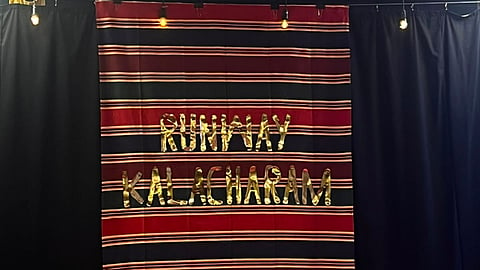

Fashion has been an integral part of queer culture. Clothing, makeup, hairstyles, and accessories have often served as tools of self-expression, resistance, and gender affirmation for LGBTQIA+ individuals. In a society where identity is frequently questioned, feared, hidden, and policed, fashion has become a way to communicate who one is. This relationship between self-expression and belonging took centre stage at Runway Kalacharam, a fashion show organised by Nangalum Nirangalum at IDAM The Space on Saturday.
A ‘Queer & Here’ badge, jamakalam serving as a backdrop, bandana tied to the hip, Madras Checks reimagined into contemporary silhouettes, flowers carrying the fragrance and confidence, intricate alta designs signifying vitality, and mehendi designs rooted in tradition transformed the runway into a celebration of individuality. Each look reflected a deeply personal interpretation of culture and identity.
Mascurine, founder of the collective, believes that fashion was the ideal medium to tell these stories. “There are a lot of gender stereotypes, judgments, and so many things associated with fashion. It is not just clothes used to cover your body; it is much more than that. I wanted to use fashion as a political statement for the queer community because fashion is a part of queer lives. It is not only about dressing up but also about affirming gender,” he says.
The idea of fashion as resistance was echoed by chief guest Negha Shahin, an actor, who reminded the audience of Pride’s roots in activism. “The P in Pride stands for protest,” she says. The sentiment resonated with the evening’s larger objective of challenging stereotypes that position queerness as separate from Indian culture.
Through garments inspired by local traditions and symbols, participants highlighted the historical presence of queer people in the subcontinent. Mascurine points to temple sculptures, the Kamasutra, and spiritual literature as examples that demonstrate how queer people have long existed within Indian society. Yet, queerness is perceived as a Western influence. He says, “We wanted to break that stereotype and statement. We are going to question culture, reshape it, and make it as inclusive as possible for the coming generation.”
Questioning, according to Mascurine, is central to the idea of culture itself. “Every time you express an ideology, you are questioning something that already exists. The main idea is representation, and questioning is always a part of it.” The event was ultimately about visibility. “The next time someone asks, ‘Have you seen a queer person?’, the answer should be ‘Yes’. I have seen them as a model,” he says.
The organisers conducted four model-training sessions before the show. Designers worked closely with participants to create custom-made outfits that reflected one’s identities and confidence. “People have always been told what not to do. We wanted to give them the experience of being professional models,” he says. The show, followed by dance and music performances, was meant not only for those on the runway but also for children who constantly questions their identity and searching for belonging. “Even for queer children who feel alone or confused, this representation can be a glimmer of hope,” notes Mascurine.
Launched in March, Nangalum Nirangalum plans to continue creating such spaces beyond Pride Month. “It is not just June. We want to do events throughout the year,” Mascurine says of his plans. At Runway Kalacharam, the message was sent out loud and clear that culture and queerness are not opposites, but identities that can walk the same runway, and pride is not just a month but a way of life.
