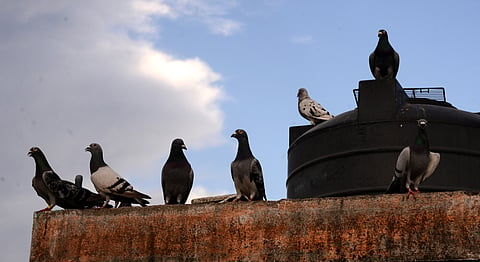

Pigeons: Their flocks, their purring calls, the nests tucked away in corners, the feathers that drift into our homes with the wind. This is perhaps how most urban dwellers would describe the bird. Some might even call it a menace, given how many homes and housing societies have had to install large nets to keep pigeons from leaving their droppings on balconies, corridors, and hallways.
But pigeons do more than simply squat. They, especially the homing pigeon breed, possess a remarkable ability shared by many birds: the instinct to navigate their way back home. Deeply centred around their lofts, they almost always find a way back, much like humans returning home from a trip. It is this resilience and extraordinary sense of direction that gave birth to pigeon racing, a niche sport.
Chennai has long been an active hub for the sport, even if it exists far from the spotlight enjoyed by mainstream sports. Across the city, a handful of pigeon racing clubs are home to enthusiasts who breed, train, nourish, clean, and care for homing pigeons. These clubs also host races that differ in distances, ranging from as little as a couple hundred kilometres to as much as over a thousand kilometres.
For each race, an enthusiast will select a few of his fit birds and register for them to participate by paying a fee. All contending pigeons are then transported to a specific, distant, pre-decided location and will be released simultaneously. There are no rules. The bird that returns to its home loft in the shortest time is declared the winner.

In a record-breaking feat, a pigeon on a racing distance of 1,850 kilometres held by Royal Pigeon Society, recently found its way back home to Velachery all the way from Delhi in just 16 days — a first for the city’s pigeon racing community in several decades. The pigeon’s owner is S Raja, a software engineer who has been a passionate pigeon racing enthusiast since 2014 with almost 150 birds at his home loft today.
It began with just him caring for three birds in 2008 on his terrace to escape work stress. The attachment led him to caring for more birds over the years, which eventually led him to discovering pigeon racing as a sport in 2014.
How it works
Every racing pigeon is assigned a unique identification number by its club within a few days after birth. Eventually, when the birds come of age and are chosen for racing, the organising club attaches an additional rubber ring to one of the participating birds’ legs. The tag carries both an outer and an inner number. While the organising club records both numbers, owners can only see the outer number, with the inner number remaining concealed, Raja explains.
Once tagged, the birds are transported to the designated starting point and released for the race. “When a pigeon returns home, its owner must immediately remove the tag, verify the concealed inner number, and update the information on an application called Racing Manager,” he adds. The organising club then cross-checks the details submitted through the app, verifies the bird’s return, and officially declares the winners.
His bird that set a record was tagged on the evening of May 4 and it began the race on May 6 from Delhi. Sixteen days later, on May 21, around 8.30 am, the pigeon reached Raja’s home loft. On May 23, another pigeon racer Nithish Adhithya, registered under the name Nithish Karthick, from KK Nagar saw his pigeon return, bagging the second place in the event.
Both Chennai residents beam with pride over the record they have helped create. According to them, there has been no known instance in the past 30 to 50 years of a racing pigeon returning home to Chennai from Delhi in under 17 days. In 2017, a bird came back to KGF from Delhi in 18 days, but 16 days is the latest record, the organisers from Royal Pigeon Society confirm. Deemed to be experts today, they offer a glimpse into the dedication that goes into the sport, explaining how the birds are bred, cared for, and trained.
Window to the pigeon world
Nithish has 200 pigeons at his home terrace and confesses to have taken a liking toward the species from the age of eight. “I am partially blind now but since I have been interacting with pigeons from childhood, I can identify them with just my touch. I also understand their muscle development with my touch. That helps me assess which birds I should choose for a race and which birds can be used to breed healthier racer pigeons,” he says. Raja adds that the pigeons chosen to breed are called stock birds by the community.
“Pigeons actually mate for life…both the male and female will hatch the eggs for a period of 18 days and once the babies are born, they both will feed milk, which is called crop milk,” Raja shares, highlighting some lesser-known facts about these birds.
Many racers use this strong pair bond as a strategy to encourage birds to return home faster in racing, Nithish informs. Some pair their birds before a race and then release one of them, banking on its instinct to return quickly to its mate and the eggs they may be incubating. Others take the strategy a step further, allowing the eggs to hatch before sending a bird off to race, trusting that its urge to return and help feed its newly hatched offspring will drive it home as swiftly as possible. “These are secrets and each person will use a different strategy. Many don’t disclose these things,” Nithish quips.
Before sending them out on races comes the training, which entails owners travelling to a certain distance with the birds and releasing them, testing to see how quickly they return home.
Beyond strategising and racing lies the everyday labour of feeding, cleaning, and maintaining the birds. Both Raja and Nithish say that they spend anywhere between Rs 8,000 and Rs 12,000 monthly to feed their birds. The cost is high because they try to nourish them with 20 or 25 different types of grains and seeds. That in addition with water, Raja says, makes for healthy racer pigeons.
It is almost like a therapeutic routine for Raja. He shares that he drops his children off at school every morning and spends two hours, between 8 am and 10 am, cleaning and feeding his birds. He then leaves for work, banking on his wife or father to feed the birds once again in the evening. Meanwhile for Nithish, help becomes a necessity to maintain his birds owing to his partial vision loss. “I have my friends who are like brothers. They help me with cleaning and feeding.”
Infrastructural gaps
Like all living creatures, racing pigeons are susceptible to illness from time to time. Whether it is heat stress during the scorching summer months, the flu, or other common ailments, it falls upon their caretakers to spot the early signs of distress, nurse them back to health, and ensure they are fit enough to fly again. Nithish says that he can notice the common signs of distress, which includes the bird not eating properly, hair loss, or a slightly warmer body temperature. He also details how caregivers regularly scan the mouths of pigeons to look for sores inside. “I can even tend to wounds, and I used to stitch wounds up before. Now I find it difficult due to vision issues. I have taught my brother so he now stitches wounds. I also prepare oils to heal the stitches. These are all basic first aid that the community knows really well,” he shares.
Beyond basic home remedies and care, pigeon owners say there is limited veterinary support available for pigeons in Chennai. Access to specialised treatment is scarce, and over the counter medicines formulated specifically for pigeons are often difficult to obtain. As a result, many enthusiasts have come to rely on personal networks built over years within the pigeon racing community to source and import medicines from abroad whenever their birds require treatment.
One might assume that a community willing to invest so much time, effort, and money into breeding, caring for, and training racing pigeons would stand to gain significant material or monetary rewards from winning. But that is far from the case. Some clubs may announce prize money, some might not. “This is because clubs incur a lot of expenses to host a race. They have to transport and organise. But there will be certification. It is just a matter of pride and passion,” Raja says, adding, “We see a bird hatch from the egg, grow for months, and train. The moment when we see it reaching home from a great distance while racing, it truly becomes a priceless moment. It makes us so happy and we will always be at a loss for words to describe that feeling.”
And so, the next time you spot a pigeon perched on a ledge, remember that it may be more than just another city bird. It could be a remarkable athlete, capable of navigating hundreds of kilometres with astonishing precision on its journey home.