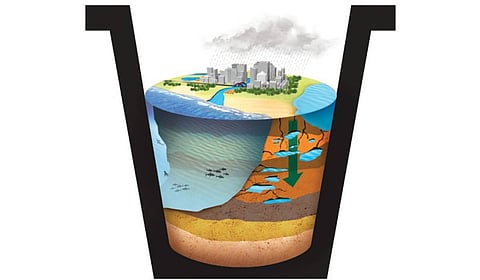

CHENNAI: Seawater intrusion has affected the groundwater to an extent of 260 sqkm in Greater Chennai region, finds a study by the Central Ground Water Board (CGWB) under its National Aquifer Mapping and Management Programme (NAQUIM 2.0).
The freshwater-seawater interface has extended inland up to 17.3 km at BN Kandigai in the north, and up to 1.5 km at Uthandi in the south, the highest inland penetration recorded in the southern part of the region.
“In total, 260 sqkm in Greater Chennai has been zoned as having seawater intrusion. In Chennai city, the built-up area occupies the largest share, covering 374.83 sqkm (84%) out of 446 sqkm. Most parts of the city are prone to waterlogging during monsoon,” the report said.
Despite 84% of the city being covered by built-up area, annual groundwater recharge has nearly doubled between 2020 and 2025. Total recharge stood at 5,236 ham (hectare metres) in 2020, and rose to 9,796 ham in 2025, largely due to rain, which alone contributed 7,643 ham in 2025, up from 4,492 ham in 2020.
Between 2022 and 2024, annual recharge exceeded 10,000 ham. The city has received normal to excess rainfall during the northeast monsoon season since 2020. However, extraction continues to surpass recharge. “Despite the rise in annual extractable groundwater resources to 8,917 ham by 2025, total annual groundwater extraction remains consistently higher at 10,854 ham, driven largely by domestic and industrial consumption (10,685 ham) rather than irrigation,” the report noted.
The report flagged rapid urbanisation, loss of lakes and wetlands, and increased borewell dependence as factors reducing recharge. A comparison of groundwater assessment data from 2020, 2022, 2024 and 2025 shows a gradual rise in stress across the city, with population growth and urban expansion identified as key drivers of depletion.
The report recommended rainwater harvesting, artificial recharge, wastewater reuse and regulation of groundwater extraction as essential measures for long-term water security.
What the CGWB data across 21 monitoring locations (2015 to 2025) say about groundwater levels
Rise in groundwater levels at 11 locations: Pallavaram, Maduranthagam, Guindy, Puzhal, Minjur, KK Nagar, Chengalpattu, Aminjikarai, Alamathi, Agaram and Chitlapakkam
Declining trends at Sholavaram, Ponneri, Guduvanchery, Taramani, Padappai, Chepauk, Besant Nagar, Alwarpet, Adyar and Acharapakkam
Highly urbanised firkas such as Ashok Nagar, Purasawalkam, Vepery, Korattur and Aminjikarai recorded high extraction due to rising domestic and commercial demand
