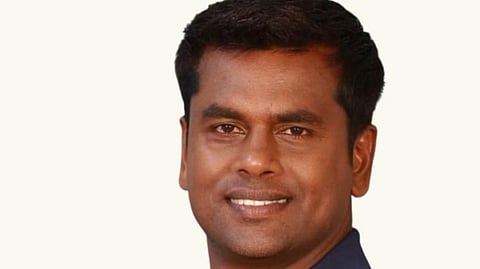

Raman Vijayan was in Class 9 when he first watched a football World Cup on TV — the 1986 tournament held in Mexico. He was excited to watch Diego Maradona play. “Our coach (in the sports hostel) would take us to his friend’s house at night to watch TV. We would be ready by 10.30 pm, travel for 4-5 km, and watch on a black and white TV. But we watched the finals in colour,” he reminisces as he recalls some of his fond memories of football, a sport that became his bread and butter. Alongside this memory, etched is the 1994 World Cup, in which Brazil won. Four decades later, with the United States hosting matches that kick off at odd hours for Indian viewers and no Tamil commentary on air this time, the former India striker, who won 30 international caps and played for prominent clubs before turning Gokulam Kerala FC women’s coach, speaks about the game this FIFA season.
Excerpts follow:
Why do states like Kerala and West Bengal have such deep football cultures, while Tamil Nadu’s support stays limited to pockets such as North Chennai?
In Bengal and Kerala, the football culture developed at scale and shaped society itself. In the 70s itself, there were professional clubs in Bengal. So the culture grew in a family-oriented, community-driven way. Mohun Bagan Super Giant, East Bengal FC, and Mohammedan Sporting Club, the top three clubs, were called the Mecca of Indian football.
Kolkata’s fields have hosted some of the world’s greatest players, from Pelé and Maradona to Messi. I played 12 years as a footballer in Bengal, so I know how they celebrate footballers. In Kerala, every village knows about football, and they follow the World Cup very deeply. There are a lot of Brazil and Argentina fans.
In Tamil Nadu, football once thrived in North Madras, Madurai, Kanniyakumari, and Ramanathapuram, but cricket overtook it as the dominant sport. Football fever here now peaks mainly during the World Cup, and people ask when India will finally play in one. The truth is that cricket’s dominance pushed other sports into the background. We are not short of talent. The sport has to be treated as something as important as community or religion.
With matches starting late at night for Indian viewers, do you think the time difference lowers engagement?
It makes following the tournament difficult, but fans manage. There are also choices to watch different matches. This generation has already watched European club football closely, and they carry that habit into competitions such as The UEFA Champions League and Copa América, most of which also run late at night or early morning. A person might catch two or three matches rather than every game, but I do not think interest in the World Cup itself will fall.
As a former Tamil commentator, do you think it is a missed opportunity that there is no Tamil broadcast this time?
It is a huge disappointment. I commentated in Tamil during the last World Cup and saw firsthand how deeply Tamil audiences connect with the game. Commentary in one’s own language builds a connection with the game. Many fans have called me personally or written on social media about its absence this time. I hope Tamil commentary returns for the next World Cup.

How has the way you watch a tournament changed?
We grew up watching individual ability and creative players with distinct personalities on the pitch. Every team had its own identity. Now, I feel like football has lost some of its earlier charm. Today, the game is faster, more tactical, and coaches shape it far more than before. That has come at the cost of individual flair. Fans still recall specific players and moments from old World Cups vividly. A good thing is that football has become more global, and a lot of people have gained football knowledge. In my opinion, the 32-team World Cup format had a unique charm, competitiveness, and excitement. With 48 teams, the tournament has become too large, and some of the exclusivity and prestige that made the World Cup special seem to have been lost
Which teams and players are you most excited to watch?
I have always admired Brazilian players, and Brazil remains one of my favourite teams. I have also been rooting for Argentina since the time of Maradona. But for producing exceptional individual footballers, Brazil stands apart. Since I was a striker, I followed the games of Romário and Ronaldo Nazário from Brazil. Recently, I have enjoyed the games of Spain, France and England. Germany always maintains a standard for playing. Also, stars like Ronaldo or Messi, shouldn’t be missed from my list.
Can football remain separate from politics?
No, it is not possible. Football is the world’s biggest sport, and a sport of that scale cannot exist without touching politics. In many countries, political backing has taken football to greater heights. The same applies here. If governments and state-level administrators take real responsibility, the next generation can genuinely believe India will play in a World Cup one day.
What would you say to young fans across India staying up through the night for this tournament?
Football’s popularity here has grown over the past 10 or 15 years, much of it down to Cristiano Ronaldo and Lionel Messi. My message to young fans is not to stop at admiring a player. Learn their journey, their discipline, the effort behind their success. Do not be satisfied with wearing a jersey. Indian football now offers more opportunities than it once did. Seek them out, and try to find the path that could make you a footballer yourself.
Has any player, coach, or legend left an influence on you?
Diego Maradona, certainly. In 1986 he was the best player in the world, and for the 10 years that followed, until around 1996, he remained a driving force in my life. Before that, our ambitions went no further than playing for a club or a state team. Maradona showed us a player could achieve global recognition while representing his country, and that was when I decided I wanted to play for India. I did, a decade later, and was able to inspire younger players the same way. Romário was another player whose style left a lasting impression on me.