
When the cloudy wheat milk is poured into hot steel vessels and mixed with ghee and cashews, it darkens slowly, thickening into a glossy, chocolate-brown mass. You separate it from the vessel and wait for a few minutes. What cools on the tray is the dense Tirunelveli halwa, carrying the taste of a place that is several hundred kilometres away from wherever you are eating it.
For generations of Tamil families, this halwa has travelled in newspaper parcels on overnight trains, becoming a symbol of love and affection.
Moses Dharma Balan, founder and managing director of Aaladipattiyan, understood the sentiment behind the halwa long before he understood much else about business. What he built from that understanding — along with seven of his friends, over ten years and across 68 outlets in Chennai — began with this sentiment and being authentic to it.
The ancestral route
Moses grew up in Aladipatti in Surandai, Tirunelveli district, where his father ran a grocery shop, and listening to tales from his mother. She spoke often about her own father, who went to the Tirunelveli market each day to sell vegetables and returned with halwa for her. “She reminisced that taste and would wonder whether she would ever get halwa like that again. Because of those stories, halwa became part of our family memories; our favourite sweet. For us, a happy day always meant halwa and tea,” he recalls.

Moses and his family visited Chennai for the first time in 2008 for a cousin’s wedding. Having grown up among two-storey buildings in Surandai, Moses found the city’s skyline enticing. His impression of Chennai stayed with him. He says, “It was like the law of attraction. I liked the city very much and from then on, I felt that one day I had to come and live here.”
He returned home to finish his BBA and told his family that he wanted to move to Chennai for an MBA. Their financial situation didn’t allow him to make a move immediately and he began doing digital marketing work from a computer that his father bought for him to earn savings. By 2011, he had put enough aside money to make his case to move to Chennai, and his family finally agreed. He gained admission to SRM Arts and Science College, and arrived in Chennai with five friends from neighbouring villages, within seven kilometres of Surandai.
In the city, Moses unlocked the halwa nostalgia and searched for shops that sold Tirunelveli halwa. Even though a lot of stores offered the label, it didn’t come with the authentic taste. He says that much of what was sold was cornflour-based, different in texture and taste from the halwa his mother had described. He noticed the gap for this halwa in the city and hoped for a business plan someday.
Building a brand
In 2013, SRM organised an entrepreneurship event that encouraged students to apply their business skills. Moses and his friends brought halwa from Tirunelveli, including karuppatti halwa, and a few other varieties and sold it fresh. “The response was very good. We achieved strong sales and good profits and also received awards and recognition. That gave us confidence and encouraged us to take the idea seriously,” he says. Over the following year, while still in college, they set up stalls at IT company events, trade centres, and festivals. Moses continued his digital marketing work on the side. All the while, he watched how customers moved through crowded tea shops and bakeries, what they picked up — to build his own empire.
He graduated in 2014 and launched halwakadai.com, selling Tirunelveli halwa and mixture. The starting investment was between Rs 5,000 and Rs 10,000, pooled from part-time earnings. Each member of the team contributed whatever they could, some bringing weighing scales and other basic equipment. His mother also supported them financially when they opened their first physical shop. “We sold products, earned small profits and reinvested the money. We gradually built everything step by step,” he says.
Within three or four months of launching a Facebook page, they had gathered more than one lakh followers. In 2016, they opened their first branch in Guduvancheri, offering halwa, karuppatti halwa, palkova, and mixture. “Customers began driving to Guduvancheri to buy directly rather than wait for delivery. That was when we realised we should open a physical shop,” he says.
The expansion was not straightforward. “We made mistakes while selecting locations. Some outlets did not perform as expected. That was when we understood the importance of branding,” shares Moses. The brand operates through a structure that he likens to a franchise model, adapted to their circumstances. While he is the brand owner, his co-founders work as regional owners, each managing day-to-day operations across their territories. Moses oversees product quality and brand standards. He points to what he calls the “zero promises of the brand” — zero maida, vanaspati, palm oil, and ghee flavouring. Across their outlets, Aaladipattiyan serves between 12 and 15 lakh customers every month.
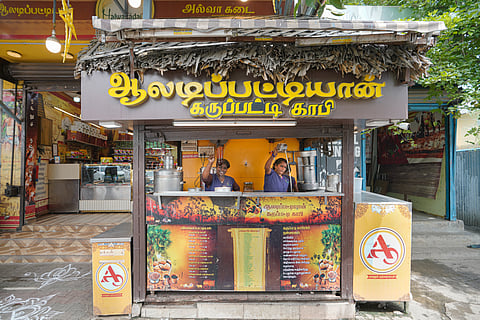
Yet, none of the Aaladipattiyan outlets bear any resemblance to Instagrammable cafes. The walls are brown and yellow, there are long benches and plain wooden tables, and the overall effect is closer to a highway tea shop. The menu lists karuppatti coffee, paal kozhukkattai, and sundal alongside breakfast, lunch, dinner, and halwa. Moses says, “We want to maintain a strong connection to our roots. That is why many of our stores employ local women. Their involvement helps maintain consistency in taste and experience. Customers are the reason Aaladipattiyan has grown from a small effort into a company. So they must always be treated with care and respect.”
The brand, with this moto, turns ten this year. With 68 stores open, Moses and his friends are working towards a target of 500 outlets, Moses says, concluding, “More importantly, I want Aaladipattiyan to become a brand that people genuinely love and trust. I want it to become a legacy brand that lasts for generations.”