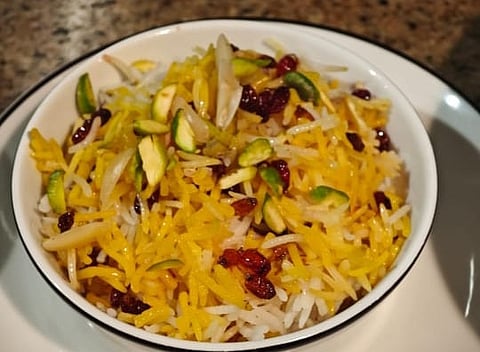

Chennai may proudly celebrate its idlis, vadais, and sambar, but only a few dishes stand the chance of becoming a crowd favourite. From 3 am drives in search of a piping-hot biryani served fresh from the dum pot to the much-loved bhai veetu biryani at wedding feasts, the city has long embraced the rice dish with fervour. Its popularity has sparked countless debates and rivalries over styles, recipes, and the best places to eat it. Among the many questions that continue to surround biryani is perhaps the most enduring one: where did it originate?
While food historians offer varying theories, one narrative traces the dish’s roots to Persia, reflecting centuries of culinary exchange between Iran and the Indian subcontinent. Though biryani has since evolved into countless regional variations, echoes of that shared heritage continue to remain. Few understand this connection like Tehran-born restaurateur Nasrin Karimi, who has called Chennai home for more than 40 years and has spent much of the last decade introducing the city to authentic Persian cuisine through Shiraz Art Cafe.
“I came to Chennai about 45 years ago as a student. And now I’ve seen a lot of changes in India, especially Tamilians. They were very conservative when trying any new food. But lately, everybody is trying new food,” she says.
For Nasrin, the similarities between the two culinary cultures are impossible to ignore. “Since Iran and India have been neighbours for many years before partition, our food habits are almost the same. Like we both eat naan, and even biryani came from Iran. The only difference is that we don’t use masala. Our food is not spicy and we don’t use chilli,” says Nasrin. She adds that she uses a signature masala to match the spicy taste buds for Chennaiites.

It is this common ground that has helped Chennai’s diners embrace a cuisine once considered unfamiliar. Operating today as a takeaway and cloud kitchen from Gems Court on KNK Road, Shiraz Art Cafe continues to serve traditional Persian dishes such as Ghormeh Sabzi, Fesenjan, Berry Polo, Chello Kabab, and Shiraz Prawn, while also adapting to changing dining habits with wraps, sandwiches and takeaway offerings.
Nasrin says that the youngsters are seeking a wider range of items that are nutrition-oriented like egg wraps concentrated on proteins. And for people who want to go beyond rice and biryani, Shiraz offers gravies, steaks, and prawns.
The journey, however, was not always easy. “Many people, especially South Indians, were very scared of touching the food, thinking that it is bland. But once they started eating, then there was no problem,” recalls Nasrin. Over the years, as Chennai’s food culture expanded beyond familiar flavours, so did the acceptance of Persian cuisine. Today, younger diners walk in asking for hummus and pita, protein-rich grilled dishes and kebab wraps, while long-time patrons return for the classics. Yet amid the changing preferences, Nasrin remains committed to authenticity.
Currently operating in Chennai, Nasrin has plans of expansion in the pipeline in metro cities like Delhi, Hyderabad, and Bengaluru. “I don’t want to Indianise the food. The food should stay the same way. And people who come after 10 years, they tell me that your consistency is the same,” she says.
That commitment extends to the way the food is prepared. Much of the larger menu is available only through pre-orders placed a day in advance, allowing dishes to be cooked traditionally and without shortcuts. Alongside the takeaway operation, Nasrin also hosts occasional Persian buffet lunches at Shiraz Villa in Uthandi, offering diners an opportunity to experience a wider spread of Iranian cuisine.
For a city that has wholeheartedly embraced biryani as its own, Nasrin’s story is a reminder that food travels, adapts, and finds new homes. And sometimes, the most beloved dishes on a Chennai plate carry with them stories that began far beyond its shores.
To order, contact Shiraz Villa @ 9840572126 or 9940149058