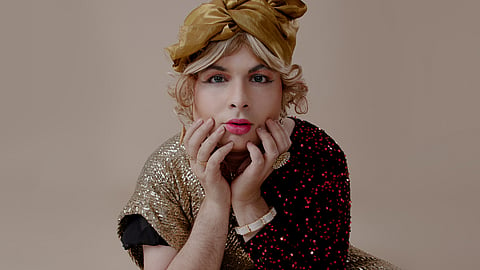

Judith Butler, in 1990, argued that gender is performative. That gender is a mere social construct that defines how one must dress, speak, and behave. Several academicians, scholars, artists, and writers have since adopted Judith Butler’s theory to challenge heteronormative structures rooted in patriarchy by combining queer theory with feminist studies.
Patruni Chidananda Sastry, a classical dancer, drag artist, author, and queer cultural practitioner, places drag within Judith Butler’s argument too. While acknowledging the global influences on the queer art form, they also place it within India’s historic performance traditions that have long been gender fluid in terms of practice; to both offer a performance manual for drag artists and to reconstruct classical practice by adopting certain ideas, questioning some, and reinterpreting some others in their book ‘Drag Sastra, A Queer Lens on Natya Shastra for the Drag Artist’ (Ukiyoto Publishing, Rs 280).
If Natya Shastra says that performance was born out of a necessity for society, Patruni argues that so did drag. They carefully place drag within the text by drawing parallels to how movement, expressions, gestures and more are similar to performance traditions of this land. And in drag’s intent to engage with queerness, visibility, and social commentary, Patruni believes it deviates from the classical theory only to mutate and fit into the contemporary world. The resulting book is a theory in itself into which Patruni has sewed in their identity; the Sastra in the title has ‘Sas’ — their drag name.
The following are excerpts from an interview with Patruni to understand how the book’s central idea was conceived and learn interesting insights from their research in the lead up to their writing of the book itself.
What was the spark for this book? Do you remember when your observations became a question you couldn’t stop thinking about?
The spark for this book came from my own journey as a classical dancer who later became a drag artist. Classical dance gave me a very structured pedagogy and was often viewed with respect and cultural legitimacy. However, when I transitioned into drag, I noticed a stark difference in how people responded. There were raised eyebrows, dismissive attitudes, and a common perception that drag was somehow demeaning or merely a Western import. That contrast stayed with me.
My turning point came during my Bharatanatyam diploma studies with Kalai Kaviri, affiliated with Tamil University. While studying Aharya Abhinaya, I encountered the concept of Roopanurupam (a performance tradition in Kuchipudi that allows men to dress as women and portray complex feminine abhinaya). As I read and reflected on it, I was struck by how closely it resonated with many of the artistic processes involved in drag. That moment felt like a rediscovery. I realised that concepts embedded within the Natya Shastra and related performance traditions could offer valuable ways of understanding drag. From there, the central question became impossible to ignore: if India has a long history of gendered and transformative performance traditions, why couldn’t we use those frameworks to better understand contemporary drag?

What about the Natya Shastra would you say is the most misunderstood by scholars and performers?
There is a tendency to treat the Natya Shastra as a sacred scripture. I see it differently. It is not an itihasa or a religious text. Rather, it is a theoretical and interpretive work — a commentary on performance systems attributed to Bharata Muni. It offers frameworks and methodologies for understanding performance, but it should not be viewed as an unquestionable authority. In fact, I believe we sometimes place the Natya Shastra on a pedestal and treat it as the ultimate word on performance. While it is an incredibly important text, it is not without limitations. Like any historical work, it emerged from a particular social and cultural context and carries its own assumptions and biases. There are ideas within the Natya Shastra that may not align with contemporary understandings of gender, inclusion, and social justice. For me, the Natya Shastra is not a rigid rulebook. It is a living framework that can be revisited, reinterpreted, challenged, and expanded through new perspectives.
Did any part of history or tradition that you came to know during your research process surprise you by how naturally they connected to your book and it’s central argument?
One of the most surprising discoveries during my research was realising just how widespread gender performance traditions are across India. There are ritual traditions where men embody feminine forms or goddesses, such as Theyyam in Kerala or Sadhoba traditions in Gujarat. There are performance traditions like Launda Naach, and theatre traditions where women perform masculine roles and men perform feminine roles. Historical examples such as Bal Gandharva in Marathi theatre, Jatra traditions in Bengal, and local forms of Bhama Kalapam in Andhra Pradesh demonstrate how gender transformation has long been part of Indian stagecraft.
I was also fascinated by the parallels between Indian ritual performance traditions and global performance theories. Practices such as Bhoota Kola, Theyyam, and even certain aspects of Bonalu function as spaces where performers become intermediaries who engage with community concerns, much like forum theatre. The biggest revelation was that queerness, transformation, and performative gender expression are not new phenomena. What often creates resistance today is not the practice itself, but the language through which we understand it.
What would you say was the hardest part or section in the book that you found challenging to write?
One of the most challenging parts of writing the book was translating highly technical performance concepts into something that would be accessible and meaningful for drag artists. I didn’t want to write solely from the perspective of a classical dancer or an academic. My goal was to create a bridge between these worlds.
How has the response to grounding drag in tradition been?
The response has been largely positive and deeply rewarding. Of course, there have also been criticisms. Some people feel that I am tampering with tradition. But I see tradition as something living rather than static. My intention is not to dismantle tradition, but to engage with it critically and creatively.
How do you think discussions of queerness in India have evolved over the past decade, and what gaps would you say still remain?
Today, there is far greater visibility for queer people than there was ten years ago. A lot of that progress has come through the work of writers, scholars, activists, artistes, and storytellers who have helped bring queer narratives into public conversations.
At the same time, significant gaps remain. Visibility does not always translate into lived equality. Many queer and trans individuals continue to face barriers in accessing employment, healthcare, education, and social acceptance. Progress is often not linear — we move forward in some areas while encountering setbacks in others.
For me, one of the most powerful ways to continue this work is through art. We often focus on queer struggles, which are important, but we must also invest in queer joy, queer creativity, and queer storytelling. Drag, in particular, embodies that spirit. It allows people to imagine new possibilities, celebrate identity, and challenge social norms while creating moments of joy and connection. That is one of the reasons why this book exists. Beyond examining performance theory, it is also an argument for why drag matters and why it deserves to be taken seriously as an art form.
Now that the book is out in the world, what conversation do you hope it starts?
More than anything, I hope this book starts a conversation about recognising drag as a legitimate and valuable art form. Drag often gets reduced to entertainment, spectacle, or stereotype, but what people don’t always see is the immense amount of skill, research, creativity, emotional labour, and self-training that goes into it. I want people to understand that drag artists contribute meaningfully to the larger artistic and cultural ecosystem. The work we create is not only about performance; it is also about identity, representation, social commentary, community building, and cultural expression.
I also hope the book encourages broader conversations about queer art and its place within India’s cultural landscape. Representation matters not only in politics or media but also in the arts.
Ultimately, I hope the book sparks curiosity — curiosity about drag, curiosity about performance, curiosity about gender, and curiosity about the histories that have often been overlooked.
What has been the most interesting reaction from readers?
One of the most interesting aspects of the response so far has been hearing from people outside the queer and drag community, particularly those from dance and theatre backgrounds. Many of them have told me that the book helped them recognise elements of drag within their own performance practices — something they had never consciously considered before.
A recurring response has been that the book encouraged readers to revisit the Natya Shastra from a different perspective. Rather than seeing it solely as a classical arts text, they began to recognise how its ideas can open up conversations around gender, transformation, embodiment, and performance in ways that are far more inclusive than they had previously imagined.
I’ve also received encouraging feedback from drag artists, who have appreciated having a framework that connects their practice to broader histories of performance. Many readers have described the book as nuanced and holistic, offering a broader understanding of how gender expression, theatrical transformation, and performance traditions have interacted throughout Indian history.