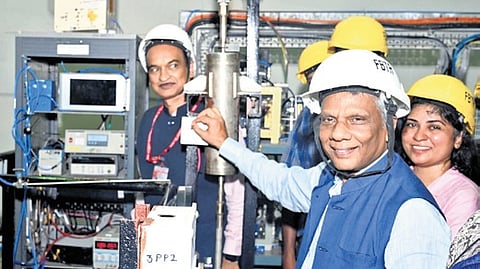

CHENNAI: The Department of Atomic Energy inaugurated the world’s first hydrogen production facility that uses nuclear process heat from a fast breeder reactor at the Indira Gandhi Centre for Atomic Research (IGCAR) in Kalpakkam on Friday. The move could eventually position atomic energy as a source not only of electricity but also of low-carbon hydrogen.
“The integration of nuclear energy with emerging clean energy technologies such as hydrogen production represents a strategic pathway towards a sustainable energy future,” DAE Secretary and Atomic Energy Commission Chairman Ajit Kumar Mohanty said while inaugurating the facility.
The pilot plant uses the Copper-Chlorine (Cu-Cl) thermochemical cycle to produce hydrogen by harnessing heat from the Fast Breeder Test Reactor (FBTR) at IGCAR, India’s only operating fast reactor research facility. The project marks an expansion of India’s three-stage nuclear programme into clean fuel production.
The Cu-Cl thermochemical cycle is one of several “thermochemical water-splitting” methods being researched as an alternative to electrolysis for producing hydrogen. Instead of using electricity to split water into hydrogen and oxygen, it uses a sequence of chemical reactions - driven mainly by heat - that cycle copper and chlorine compounds through different states, with water as the net input and hydrogen (plus oxygen) as the net output. The hydrogen production technology was developed by the Bhabha Atomic Research Centre and integrated with the reactor by IGCAR.
Nuclear power’s ability to provide continuous carbon-free electricity and high-temperature process heat made it well suited for large-scale hydrogen production, Mohanty said, adding that the technology could strengthen India’s energy security and decarbonisation efforts. The pilot plant is expected to generate operational data that will help scale up nuclear-assisted hydrogen production in future advanced reactor systems.
