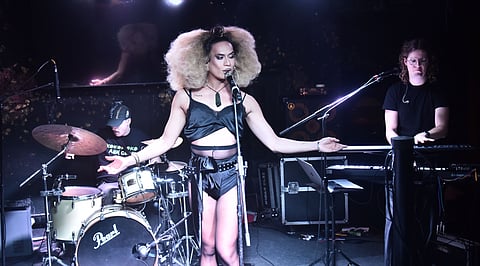

Under shifting spotlights and the excitement of Friday evening setting in, Black Orchid Restobar in RA Puram transformed into a space of celebration. The audience gathered around the dimly-lit venue, cocktails in hand, waiting for an artiste who had to set the tone for the evening.
Clad in all black, the artiste holding the mic and audience’s attention that evening was Jamaica Moana and her band, who travelled seas to tour three Indian cities this Pride Month. This visit was part of the Australian Consulate-General, Chennai’s broader Pride Month programming and year-round initiatives to promote gender equality and LGBTQIA+ rights, while showcasing contemporary Australian creativity and fostering cross-cultural connections through music and storytelling. The event was hosted by the Australian Consulate in partnership with Orinam, an all-volunteer informal collective in Chennai.
Before the music took over the room, Jamaica sat down to speak about ancestry, queerness, cultural exchange, and the power of being seen. The proud Maori (Ngapuhi/Tainui) and Samoan artiste’s stop in the city, after performing in Delhi, was not simply for another concert, but as the beginning of a conversation across cultures. “My culture shaped me as the artiste I am today through resilience and strength. My ancestors were very strong and resilient, so I carry them with me every day through my career,” says Jamaica, who donned the traditional hei-tiki, an ornamental pendant of the Maori of New Zealand, at the event.
Growing up in Western Sydney, Jamaica never struggled to reconcile her multiple identities. Instead, she credits colonisation and a Westernised worldview for creating those divisions. “My culture has always catered to somebody like me. It was the westernised point of view that changed that. And my music definitely helps cater to a space to allow me to be free,” she explains.
Her music is a blend of rap, R&B, soul, and punk-edged alternative pop. Explaining this choice of sound, Jamaica notes, “I’ve always loved pop, reggae, and cultural music. Right now, I’m a melting pot of genres. That might change throughout my career, but this is how I exist today.”
The show opened with Keep It Real, a song dedicated to her late father, who passed away nine years ago. Opening every live set with the track, she says, has become a deeply personal ritual. “I finally spoke about that story in my debut EP (Extended Play, an artiste’s first official music collection). Now it helps other people heal, too.”
Representation, she believes, is just as powerful as music itself. “If queer indigenous people don’t see themselves in music, films or the media, they’ll feel like they don’t belong. Visibility makes it easier for the next generation.”
For the artiste, spending a few days in the city marks more than a stop on an international tour. Having “studied” yoga and meditation with her family at an Indian temple in Australia, visiting India has long been a personal aspiration. “I’ve always been obsessed with Indian culture. The way India prioritises meditation, yoga; and being aware of your body is really inspiring.”
While Jamaica admits she knew little about India’s LGBTQIA+ community before arriving, the visit has broadened her perspective. She also hopes to learn more about indigenous communities during her stay. The tour is in equal parts about listening as performing. “My priority is to exchange my culture while learning about yours and finding a sense of home with people across the world.” Jamaica found her calling in the collaboration with Hashbass, a bassist, producer, and sonic architect known for his lush neo-soul, funk, and R&B-infused sound. The release of this musical partnership is expected in late 2026.
As the evening went by, Jamaica performed an hour-long set featuring 10 songs, explaining the origin and meaning. “I want people to see my beauty before judgement — not just accept me, but accept every person who’s like me. I hope my music becomes a power for change,” she signs off.
