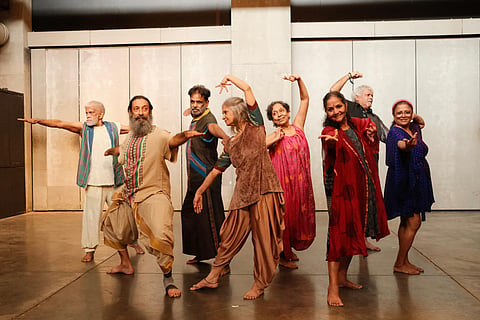

For decades, the world of art and culture has thrived on a shared space where veterans and amateurs came together, nurturing traditions and ensuring that artistic legacies flowed across generations. Yet, as many senior practitioners gradually stepped away and younger enthusiasts pursued what were often deemed “more serious” paths, that visible intergenerational presence began to fade. Years later, many of those once-passionate artistes, now freed from the demands of careers and family, are returning to the stage, rediscovering their artistic voice and proving that creative expression has no age limit.
It is this very spirit that drives Prime, a contemporary dance production directed by Mumbai-based choreographer Avantika Bahl, which brings together eight performers above the age of 60. Following multiple shows in the homeground, Prime is coming to Chennai, as part of the March Dance festival presented by Basement 21 in collaboration with Prakriti Foundation.
Avantika explains that the project emerged from a long-standing curiosity about ageing and performance. “Predominantly, my interest when I make work is, how we challenge the mainstream in the arts and how one can bring different communities into the ecosystem.” That curiosity led her to question the absence of elderly performers on stage. “I have been very interested in looking at what the relationship between movement and the ageing body is, and why we don’t see elderly performers on stage,” she notes.
The idea took shape in 2024 when she began meeting individuals over the age of 60 who had maintained some relationship with movement. Many of them, she discovered, carried stories shaped by social expectations and personal choices. “I realised they (people over the age of 60) were living archives and histories, carrying knowledge systems that may not necessarily get passed down,” she says. These encounters eventually led her to assemble a cast of eight performers drawn from varied walks of life, each bringing their own experience with dance or movement.
What makes Prime distinctive is its exploration of the idea of artistic peak. “The piece asks what being in one’s prime really means and challenges who we think is in their prime,” Avantika says. Rather than treating ageing as a limitation, the production frames it as a site of reflection, vitality, and possibility. “The work is not talking about ageing as something that needs to be feared or something limiting. Instead, it opens conversations around how one can live fully as they continue to navigate time in their bodies,” she explains.

The creative process itself was equally unconventional. The performers, many of whom came from diverse dance traditions or informal movement practices, were introduced to the vocabulary of contemporary dance. “But they trusted me from day one,” says Avantika. Over nine months of rehearsals, fragments of movement and personal expression gradually evolved into a cohesive performance. When the work was finally complete, she recalls, the cast began to see the larger picture. “They said, ‘Nine months ago, we had no idea why we were doing this, but now we get it’,” she shares.
Breaking down the structure of the performance, Avantika says, “The performance has been structured from the lens of contemporary dance but we also looked at each of the forms that the performers are comfortable in and used those forms within the language of contemporary dance.” She adds that there is a bit of Odissi, Jive, Ballet and “a little bit of everything.” Complementing the choreography is an original score composed by Rahul Nadkarni and Nikhil Narendra, with an additional finale track by Het Sanghvi, which Avantikas says helps create a sonic world for the performance.
For Avantika, the journey of creating Prime has also been deeply personal. Working with performers from another generation, she says, has reshaped her own understanding of time and presence. “They truly make the most of every single day.” That sense of joy and camaraderie, she adds, is visible in the performance itself, where “eight very unique voices, all above the age of 60” come together in what she describes as a work that is “unexpected and witty.”
The ensemble features Jhelum Paranjape, Venkatesh lyer, Venkateswaran Akileswaran, Faredoon Dodo Bhujwala, Saraswati Devdas, Sunila Ashok, Francis Dsa Cardoso, and Manuella F Cardoso, each bringing their own unique relationship with dance and movement to the stage. Sunila Ashok, who trained in Bharatanatyam from the age of four and performed until her early twenties before stepping away from dance after marriage. It was only during the lockdown that she began dancing again through short videos at home. Joining Prime, she says, meant stepping onto a stage once more after nearly forty years. The response from the audiences from previous shows has been overwhelmingly emotional. “Some said they felt a sense of hope that if people in their sixties could perform like this, they, too, could continue dancing and pursuing their art,” she says.
For Avantika, that response is perhaps the most meaningful outcome of the project. The performance, she says, opens “multiple windows into how life can continue to be celebrated,” reminding audiences that age cannot limit movement.
Witness ‘Prime’ unfold on stage at Goethe Institut, Nungambakkam on March 16 from 7 pm. Open to all.