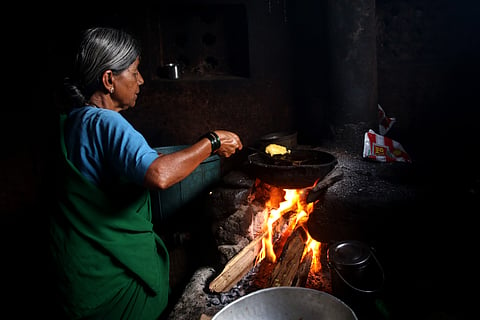

A forest fire often begins with something very small. A single spark can spread from one patch of land to another. Similarly, a single remark in a conversation about something that has long been a gendered subject can ignite a chain of regressive ideas. Once voiced, such remarks can prompt others to repeat misogynistic justifications and even reinforce outdated expectations that the society has battled for decades.
This is precisely what is unfolding on social media today. In the midst of an LPG crisis owing to the on-going war in the west, many users, meme creators, and influencers are weaponising the situation through questions, prompts, and memes that appear removed from the realities of gendered labour. Prompts such as, “What is your favourite dish when cooked on a wood-fired stove?”, “Name the dishes that taste better when cooked on firewood stoves,” and memes that attempt to evoke “nostalgia” around cooking on mud stoves are such subjects of conversations online. Redirect the attention to those who have actually cooked on wood-fired stoves and they will not speak of nostalgia.
Arulmozhi V, aged 53, recalls the physical strain that went into tending the fire for cooking. “Barring the summer months, we wouldn’t be able to find well-dried wood for the stove. Due to moisture retention in the wood, it will take a lot of time for a flame to spark. Once it starts burning too, it won’t consistently burn, forcing us to blow through the blowpipe over and over,” she explains.
At just fifteen, burdened with the responsibility of cooking for her father and three brothers, she recalls developing severe pain in her abdomen. The repeated deep breaths needed to blow through the pipe required strong contractions of her abdominal muscles, and this strain eventually took a toll on the teenager. She adds, “Since I was always in close contact with the fire, my eyes would burn, sometimes my throat and chest too would burn. This is common for everyone who cooks on wood-fired stoves.”

The intensity of these hardships varied for women depending on their economic and caste backgrounds, though it did not change the fundamentally gendered and physically demanding nature of work. Gomathi S, aged 86, admits that she almost never had to struggle with damp firewood when lighting her stove in her twenties. Her household had a steady, year-round supply of properly dried firewood that would be stored carefully to keep out any moisture, along with ample kerosene to help start the fire easily.
For those women belonging to the working class, wood had to be purchased as and when their pockets would allow it. Arulmozhi, at times, has found alternative ways during financially difficult periods. “If there was construction work happening nearby, I would ask them for the small pieces of wooden waste, collect it, fill it into the stove’s base, and use it to light the fire,” she recollects.
Class also shaped where these stoves were located. For relatively more privileged households, the stove was placed inside a covered, well-ventilated cooking space. For the others, however, that was not the case. The stove was often set up outside the house in cramped spaces without any roof above it. This meant that during rains, the stove would become completely damp, making the already difficult task of lighting and sustaining a fire even more challenging.
These accounts, however, do not just belong to a bygone era, as Nithya P, now 33 years old, shares her experiences of cooking on wood-fired stoves. “If the stove is outside and damp and a woman has to cook a basic meal for dinner, she’d have to start the process by 4 pm considering the time it will take. To just cook rice on such stoves it will take 30 to 40 minutes. In addition to this, a kuzhambu, and a vegetable, would take more time.” She then compares, “That is not the case while cooking on a cooker with an LPG cylinder.”
Nithya’s account serves as a reminder that for many people, especially those outside urban and metropolitan cities, these realities are not distant memories.
Access to firewood in rural pockets is also not as simple as purchasing it over the counter at a shop. It often requires exhausting physical labour to obtain. For land-owning communities, it is easier to obtain firewood as against the others, Nithya shares. “My family, for instance, was into betel leaf farming. We would use the roots of agathi keerai tree (used to support betel leaf farming) to fire our stoves. But if we weren’t cultivating or harvesting, both my parents would cycle a distance of 15-20 kilometres into the forest area and pick up firewood,” she explains.
She even points out that many women were and are at risk of harassment if and when they venture out alone to pick up firewood, especially Dalit women. Shalin Maria Lawrence, an intersectional feminist, corroborates, adding, “Even in the Vilathikulam case, the girl was killed because she ventured into the forest to relieve herself. If Dalit women are walking three or four kilometres in search of firewood, they would have and will still continue to be at risk.”
Scars of labour
The women who recollect the horrors of cooking on wood-fired stoves also remember how a common cold or fever lingered longer as the thick black ash and smoke from cooking irritated their lungs and throats. Resting for them, like most Indian women, was and is rarely an option leaving little to no room for recovery. The impact on their health was not only internal. Even today, women who cook three meals a day for their families sometimes sustain burns and scars, but the women say the risk was far greater when cooking on wood-fired stoves.
Today, with the simple turn of a knob, we can control our stoves. But cooking on a firewood stove demanded far more effort and constant attention. Arulmozhi explains that if she wanted a dish to simmer, she would remove one or two pieces of firewood to reduce the intensity of the flames. Doing so often led to injuries. Most of the time she burnt her fingers and hands, and occasionally her legs, too.
In addition to cooking over a fire, Gomathi and Arulmozhi were often responsible for grinding ingredients by hand using stone grinders such as the ammi kal and aatu kal, a process that left them increasingly exhausted and had to be followed up with cleaning the kitchen and the utensils.
Yet, beyond all this struggle, there are still conversations that insist food cooked this way — on wood-fired stoves and ground by hand — somehow tastes better. At best, Arulmozhi admits, the smoke from the fire might add a certain flavour to some non vegetarian dishes, but she insists it is not worth the effort and hardship involved. Nithya, meanwhile, adds that the fly ashes from the smoke would at most times fall into the food, and a burnt taste would linger in dishes including tea, milk, and rasam. As for the other physical labour, Shalin remarks, “As though it is not enough that Indian society already extracts relentless labour from women, these men want women to be more physically exhausted, stripping them off of the little freedom they have received thanks to industrialisation and modernisation.”
As far as the wood-fired stoves are concerned, these women’s experiences are not merely anecdotal. The Global Burden of Disease Study, published in 2019, found that Household Air Pollution (HAP) has caused nearly six lakh deaths across Indian households. Just a few years before this study was carried out, in 2016, to promote access to cleaner cooking fuel, the Government of India launched the Pradhan Mantri Ujjwala Yojana. The scheme claims to have expanded its reach to nearly 99 per cent of the country, making LPG connections widely accessible. However, the cost of LPG and the extent to which households are able to fully transition away from traditional fuels remain significantly understudied.
Against these already grim realities, such conversations online risk deepening the anxieties faced by many women, particularly those whose lives continue to be shaped by the overlapping burdens of caste and class.