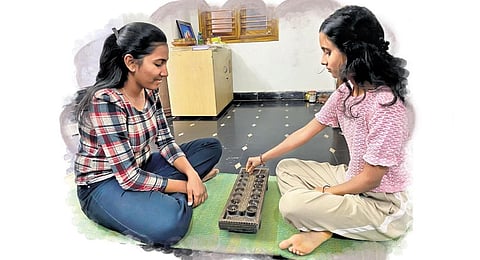

With West Asia on everyone’s mind, I thought I would take a peek at the traditional games that were played in Iraq. I could think of nothing better than Mheibes, a traditional game involving two teams, similar to other games. Here, an object is hidden in the hand. Its historical origins are unclear, but it is thought to go back to at least the 1600s.
During Iraq’s years of conflict, Mheibes — the traditional Ramadan game built around collective play and large gatherings, music, and shouting, — slowly disappeared from public life. The game retreated into quieter, more controlled spaces — private cafés, guarded halls, or neighbourhood corners — its scale reduced and its visibility diminished.
Mheibes’ survival through these years was not accidental. It endured precisely because it was woven into everyday social life rather than formal institutions. The game involves two teams, each attempting to hide a ring from the other. At the beginning of the game, one player goes around the team and hands over the ring to any team member. This is done carefully, with the aim of preventing the other team from knowing which player holds the ring.
The other team then nominates a player, who has to guess to find out who is holding the ring and in which hand. The decision is based on studying the facial expressions of each team member and their body language. The player can also rule out players or specific hands if he believes they do not hold the ring. If a player rules out a hand holding the ring, the ring is exposed, and there is a huge shout.
Games such as these are not just the social glue that hold communities together; they are also incredible education in non-verbal cues and communication — an art slowly dying out with increased online interactions.
Another fascinating game from Iraq is the game of Sinya or Sini Zerf. In this age-old game, players strive to uncover a hidden ring, a dice, or a coin under one of 11 miniature copper cups placed on a circular tray. The tray signifies the year, while each of the 11 cups represents a month, with the 12th cup missing as that would represent the month of Ramadan.
Sini Zerf demonstrates how games encode learning without formal pedagogy — teaching memory, symbolic thinking, and social participation through ritualised play. This makes it directly comparable to many traditional Indian games that teach time, chance, and social order without classrooms or textbooks. These guessing games are similar to games played in India, where a player conceals some small objects in the hand, and the opponent tries to guess whether it is an odd number or an even number.
Any article on the games of Iraq would be incomplete without mention of the royal game of Ur. Archaeological evidence shows that the game was being played as early as c. 2600-2400 BCE, making it perhaps one of the oldest known board games in the world. The game takes its name from the most famous boards excavated by Sir Leonard Woolley in the Royal Cemetery of Ur in the 1920s. But more on that in my next article.
