
If you are a first-timer in the city, ask any Chennaiite for a must-visit spot, and fingers will instinctively point to Marina Beach. Perhaps, it is because the shoreline holds so much of the city’s history and culture, from Napier Bridge and the memorials of Tamil Nadu’s political leaders, to MA Chidambaram Stadium — fondly called the Anbuden, the lighthouse, the All India Radio station, and now adding a feather to the hat, the recent Blue Flag recognition. A little away from this landscape, closer to Pattinapakkam Beach, stands St. Thomas Cathedral Basilica.
A landmark in its own right, the Santhome Cathedral consistently draws a steady stream of pilgrims, tourists, and curious passersby alike throughout the year. Its historical and spiritual significance has long made it a site of gathering, especially during key worship seasons. Recently, however, the crowd is drawn not just by prayer, but by an immersive artistic experience.
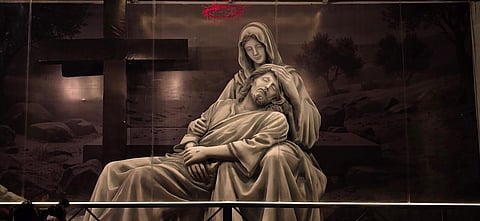
Created by Charles Bronson Doss, founder and event architect at Believe San Decors, the work deviates from traditional representations, instead inviting viewers into a quieter, more introspective experience of grief and solace. “This [installation]is inspired by the Pietà in the Vatican, but it is not exactly the same,” says Charles. The Pietà, created between 1498 and 1500 by Michelangelo, represents the body of Jesus on the lap of his mother, Mary, after the crucifixion. However, Charles’s interpretation shifts the focus. “We all know what Jesus suffered, but I wanted to show what Mother Mary would have gone through and ultimately, where Jesus found his peace, in his mother’s lap. I want people to see that, and relate to it,” he says.
A recent social media reel posted by a visitor spoke volumes about how the mere sight of the installation brought tears. For some, it could be the personal resonance while for others, a cathartic moment.

Set against the backdrop of the Lent season [a period of fasting], the installation shifts focus from the widely depicted suffering of Christ to a more intimate perspective. The process behind the installation was as meticulous as its intent. Over 32 days, Charles’s team of around 20 members worked through multiple stages, from conceptual sketches and 3D modelling to execution by artists. Built using thermocol with puffy infusion, and Plaster of Paris (POP), the 12 feet by 14 feet structure ensuring cost effectiveness and aesthetics. “If we were to create something like this in real material, it would cost somewhere around ₹20-30 lakh. This is meant for display, to let people experience something they otherwise cannot. So we chose materials that are budget-friendly but still bring out the vision well,” Charles notes, adding that the installation tentatively costed around ₹6 lakh.
Yet, beyond the structure, the most demanding aspect lay in capturing emotion. “The only challenge was bringing in the emotion in the faces of Jesus and Mother Mary. Even after the full design was ready, I wasn’t ready to put it out because I wanted the expression to be exactly right, something people could truly connect with,” he says. The detailing required the effort of six to seven artists working specifically on the faces, ensuring that the intended sentiment translated seamlessly to the audience.
For Charles, the project is also deeply personal. “Whatever I am today started here, at Santhome. I began with youth activities and small decorative work at the church, which eventually led me to become an event planner. Even after pursuing my master’s in the UK, I returned because I felt deeply connected to my people and this place,” he reflects.
That connection perhaps explains the overwhelming response the installation has received. Within days of its unveiling, the church saw an unexpected surge in visitors. “The response has been enormous, more than what we expected. We had to request people to leave the premises at around 11 in the night,” he recalls. More than the numbers, however, it is the emotional engagement that has stayed with him. “When I stand far and see people looking at the statue and even shedding a few tears, that’s when I feel, ‘you did it.’”
Reflecting on the impact, he adds, “I set out to create something that mirrored the image of God, and the result was deeply soulful. It became more than just a model; it became a sanctuary where people came to pray and connect with the same truth I believe in.” Even church authorities appear to have been moved. “The bishop stood there for at least three minutes after the opening. He spent time telling me how he felt and how holy the experience was — that meant a lot,” Charles shares.
The installation also marks a broader shift in how religious spaces like Santhome are engaging with contemporary forms of expression. Rather than strictly adhering to canonical imagery, Charles believes in offering new perspectives. “The Bible is already known to everyone. I wanted people to visualise it from a different angle and experience something new,” he says. This approach is not new to his work, Charles has done five displays at the church in the past one-and-a-half years. Last Christmas, he recalls creating a all-white setting imagining “what if Jesus was born in heaven?”
At a space that draws people across faiths and backgrounds, such experimentation finds a wider resonance. “Santhome Church brings people from every community, every religion, that gives me the space to experiment and create experiences that everyone can connect with,” he says. Ultimately, Charles believes that such immersive experiences would make the people visit the church again.