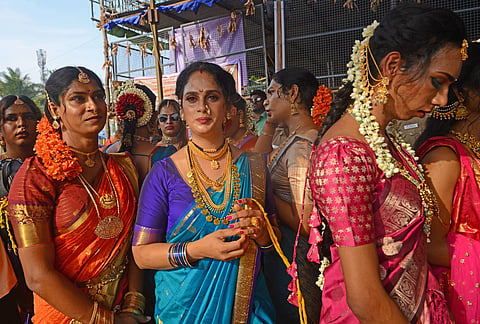

For thousands of trans women, the annual Koovagam festival at the Koothandavar Temple is a refuge rather than just a ritual. The festival draws massive crowds to Tamil Nadu’s Villupuram district, for a symbolic one-day marriage to Lord Aravan, followed by a somber widowhood ceremony.
For participants, the celebration is one of the few places where acceptance outweighs fear. This year, the event attracted hundreds of journalists, photographers, and YouTubers, but at its heart remained the deeply personal stories of the Aravanis: one of escape and return, another of discovery and acceptance.
Safe haven
For Rossy, a trans woman and beautician based in Bengaluru, Koovagam is home. Currently on her third visit, she prepares extensively for the event, having even read the ‘Mahabharata’ in Tamil to fully understand the story and significance of Lord Aravan.
Preparing for the festival is a year-round financial commitment. “For the marriage ritual, you need so many things. I want to really look like a bride: a new sari, cosmetics, footwear, and hotel bookings,” Rossy explained, noting that accommodation costs surge during the festival. “The next day, I need a white sari for the widow’s ceremony. It’s expensive, but I love to come back again and again.”

Rossy’s devotion to the festival is sharply contrasted by a painful past. Born into a Muslim family in Kerala, growing up, she faced isolation and rejection. “Sometimes my father and brother used to beat and harass me for wearing saris or girls’ clothes,” she recalled. Traumatised, she left home in her early twenties and arrived in Bengaluru without knowing anyone. Her life changed when a chance encounter at a local market led her to a trans woman who became her adopted mother. “She spoke to me and I felt safe. She asked me what training I wanted, arranged a beautician course, and paid all the fees. By God’s grace, I am earning well today. For me, she is like a godmother,” said Rossy.
Terrified of retribution, Rossy fiercely guards her birth name and has severed all ties with her biological family. “I still feel scared. If my family finds me, I fear they might kill me. I feel I am not Muslim anymore. That was my past. Now, I am neither Muslim nor Hindu. I am a trans woman, and I follow our community’s traditions,” she shared.
A Thai visitor
While Rossy sought refuge from her past, Zuu, a trans woman from Thailand crossed international borders fuelled by curiosity. A finance professional who has worked with several Japanese companies, Zuu discovered the festival on YouTube and was instantly fascinated.
Reaching the rural village on April 27 required weeks of effort. All searches yielded no specific dates, and Thai travel agents were unaware of the event. She finally succeeded by coordinating through an Indian travel agency, its Chennai partner, and a local contact in Villupuram.
Before arriving, Zuu was highly apprehensive. “I received a lot of negative feedback in Thailand that people in Tamil Nadu are rowdy and might harm me. I was concerned about how they would look at me and treat me,” she admitted.
Those fears vanished the moment she arrived. “Everyone accepted me. All my negative thoughts were washed away,” she said. Over the course of the festival, more than 1,000 people took selfies with her. “The people in this village showed me so much love and respect.”
Moved by the overwhelming acceptance in a countryside village nearly 200 km from the state capital, Zuu is already planning her return. “Next year, I will definitely wear a sari, blouse, and jewellery like an Indian bride. I feel like I am a part of this festival,” she said.
Though they come from different worlds, Rossy and Zuu leave Koovagam with the same sense of renewal. Both carry with them the same promise. For the community, the road ahead may be fraught with the same societal hurdles, but the memory of Koovagam remains a beacon, ensuring they will return next year to the place they can truly call home.