
This is a question I have grappled with for a long time. In principle, a traditional Indian game should be one that originated in the Indian subcontinent, was played across generations, and is rooted in local culture and community life. In short, it is those games people in India played long before modern toys, boards, or packaged rules using simple materials, shared rules, and community memory.
Most of the games we consider traditional fulfill almost all these rules. The challenge often is in pinpointing the origin. Was a game actually born in India or did it travel so long ago to India that it has become a part of our culture and community? These are difficult questions to answer.
One of the games I get asked about most often is Brainvita. This is a solitaire-type puzzle, typically played on a wooden board with marbles or pegs. The goal is to jump pegs over one another and remove them, ending with a single peg — usually at the centre.
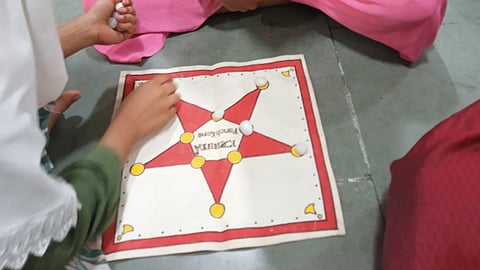
In many Indian households, it has been played for decades as a problem-solving game. However, there is little evidence that it was played in this form in traditional times. The closest is the game of Panch Kone or Nakshatra Vilayattu which is played on a board shaped like a five-pointed star. The concept is the same but the form we know as Brainvita today shows up in no evidence at all.
The closest information on the origin of this game is not from India but from Europe and the game of peg solitaire.
The earliest documented reference to peg solitaire appears in France in 1697, during the reign of Louis XIV. The game was described in the French literary magazine Mercure Galant, which included the board layout, rules, and sample problems. An engraving by Claude-Auguste Berry from the same period famously shows the Princess of Soubise playing the game, confirming its presence in French court culture. Although there are other claims to its origin, most historians believe that 17th-century Europe is the verifiable source of the modern game.
But what makes Brainvita, as it is known in India, feel almost traditional to India? Perhaps because it became indigenised through local wooden craft traditions. Additionally, it became a part of household play with oral rules rather than structured and formal instruction. Perhaps it has something to do with the fact that a similar game, Panch Kone, existed in India and this felt like just a version of the same game. Over time, it came to be seen as part of Indian indoor play culture. Researching traditional games takes you on many fascinating journeys. You can travel around the world and even back in time through the learning and research.
What matters at the end of it all, is the game and the joy that one can derive from learning, understanding and best of all — playing the game.
