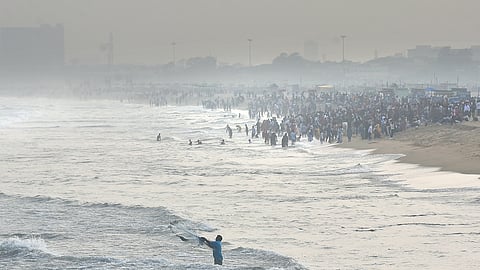

CHENNAI: After recording a spike in pollution level during Deepavali, Chennai’s air quality improved on Wednesday, with the city’s average Air Quality Index (AQI) falling to 143 by 5 pm as against 199 on Monday. The improvement, however, was far from uniform, with Manali recording ‘poor’ air quality for the third consecutive day, highlighting the persistence of localised pollution hotspots.
Data from the Tamil Nadu Pollution Control Board (TNPCB) and the Central Pollution Control Board (CPCB) showed that Manali recorded an AQI of 204 on Wednesday. Kodungaiyur recorded 158, Perungudi, 181, and Royapuram, 161. In contrast, Arumbakkam recorded a relatively lower AQI of 72, while Velachery registered 102. Only seven of Chennai’s nine monitoring stations were active.
The readings at Manali pointed to the dominance of particulate matter pollution. The average PM2.5 concentration was recorded at 204, which can cause breathing discomfort to most people on prolonged exposure.
While favourable weather conditions may help disperse pollutants across the city, local emission sources can sustain unhealthy air quality in specific pockets.
A three-year analysis by New Delhi-based advocacy group Climate Trends, which examined daily CPCB AQI bulletins across nine Indian cities from 2024 to 2026, found that Chennai experienced substantial pollution spikes during Deepavali but recovered relatively quickly within a week, what with it being largely a coastal city.
Further, Chennai’s mean AQI rose from 70 in the pre-Deepavali week to 168 during the festival window this year—an increase of 139%, which is the largest relative spike recorded in the city in the study. The study noted that Chennai’s AQI increased by 65% during the 2024 Deepavali window and 57% in 2025, before returning to lower levels in the subsequent week.
“The post-Deepavali air quality trends across Indian cities demonstrate that the pace of recovery is strongly influenced by geography and prevailing atmospheric conditions,” said Dr Palak Balyan, research lead at Climate Trends.
She attributed Chennai’s relatively quicker recovery in previous years to coastal sea breeze and seasonal rainfall, which help disperse or wash out pollutants. She, however, cautioned that the festival-related spike should be understood alongside a city’s underlying pollution conditions.
Meanwhile, TNPCB officials told TNIE that Wednesday’s readings suggest that Chennai’s overall air quality is improving, but the continued ‘poor’ AQI at Manali highlights the need for targeted action in pollution hotspots. “It is difficult to put restrictions on cargo container vehicles going in and out of ports and industries. And, road dust is a big source of particulate matter in the area. All these factors continue to elevate background pollution levels,” an official said.
