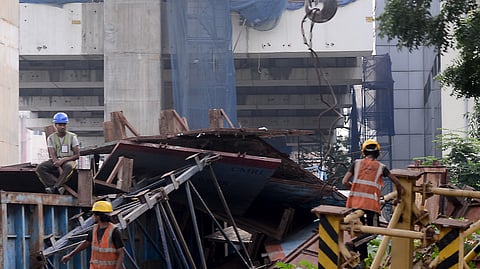

CHENNAI: Chennai Metro Rail Ltd (CMRL) has redesigned a critical stretch between Alandur and St Thomas Mount to avoid acquiring defence land and demolishing several buildings, opting instead for an unconventional engineering solution that involves constructing the Phase 2 of Corridor 5 (Red Line) beneath the existing Chennai Central-St Thomas Mount corridor and removing one supporting pillar each at two locations.
The revised alignment is expected to save about six months of construction time, while also allowing St Thomas Mount to emerge as a major interchange connecting two Metro corridors with MRTS and suburban railway services, according to T Archunan, director of projects at Chennai Metro Rail Limited (CMRL).
He told TNIE the additional engineering work involves a supplementary tender worth around Rs 300 crore. CMRL is planning a 45-day suspension of train services to undertake the critical structural work, tentatively in February-March 2027, subject to approval from the Commissioner of Railway Safety (CRS).
The original design envisaged taking the alignment through a built-up stretch, which would have necessitated the demolition of several buildings and acquisition of land, including defence land, which would be time consuming.
Taking the elevated lines to a higher level was also examined but found unsuitable because of height restrictions arising from the airport’s flight path. The alternative of routing both lines along one side would have involved further structural and land constraints, apart from affecting commercial establishments along the stretch.
Under the revised engineering plan, Chennai Metro has instead chosen to rebuild within its own footprint. The work is needed to build the viaduct for Corridor 5, a Phase 2 line that will run beneath Corridor 2 as it curves near Alandur and St Thomas Mount. One Corridor 5 track would strike an existing pier at the point where the lines merge, and another at the point where they separate.
At each of the two pillars, P42 and P27, a “portal beam” will replace the pier and carry Corridor 2 overhead, with Corridor 5 passing below. Because Corridor 2 keeps running until the final stage, the sequence matters. New foundations are laid first, angled in an A-frame shape and piled within the available land so they do not extend into defence property. Steel trusses and beams are then erected as temporary support.
Forty-five days are needed to dismantle the overhead traction equipment, remove the track, modify the supporting structures and lift two spans across the two locations, he said. Jacks transfer the viaduct’s load to the supports, the old pedestals, pier cap and pillar are demolished, and new pedestals and bearings are set before the load is lowered onto the portal.
Initially, Alandur was envisaged as the principal interchange, while the original design provided for Corridor 5 to extend towards St Thomas Mount. The constraints involving Defence land prompted CMRL to work out a revised connection with Corridor 5 at Alandur.
CMRL has indicated September 2027 as the target for completing the entire elevated stretch towards Sholinganallur.
Direct access from four towers in Thirumangalam
Chennai: CMRL has awarded a Rs 446.88 crore contract to Capacite Infraprojects to build four commercial and property towers around Thirumangalam station. The works are expected to be completed in 24 months. The towers will rise on 3.85 acres of open land on either side of the elevated Corridor-5 viaduct. CMRL said the layout would give commuters direct access to the metro from within the same tower complex. ens
The project is part of the agency’s push to raise non-fare revenue by developing land along its corridor. CMRL described it as reflecting “sustainable urban growth” and a drive to optimise the commercial potential of its network.
The contract was signed in the presence of Ashish Chatterjee, CMRL’s managing director, by T Archunan, director (projects), and Raju Bansode, assistant vice-president (business development and marketing) for Capacite. S Krishnamoorthy, director (finance), and senior officials were present.
