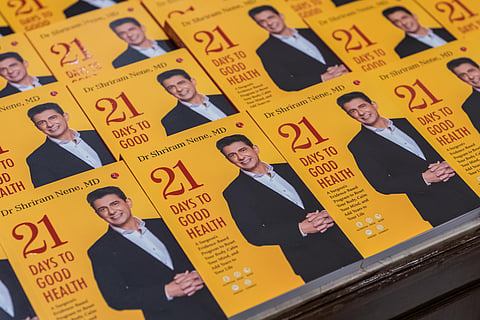

When you write your to-do list, where does the task relating to your well-being stand? Is it one of your top priorities? In between meetings and deadlines, health usually takes a back seat. In his latest book, 21 Days to Good Health (Rupa Publications India Pvt. Ltd; Rs 495), cardiovascular, thoracic, and vascular surgeon, Dr Shriram Nene makes a case for changing this pattern by treating health not as another task, but as the foundation that allows us to live that day well, just like the rest of our lives.
Launched in the city on Saturday, the book is structured as a 21-day programme, and is built around five pillars of well-being — nutrition, sleep, movement, stress and mindset, and connection and purpose. In simple language, the book details the science of good health into practical steps that readers can actively incorporate into their everyday lives. The dos and don’ts of good health don’t stop at day 21, Dr Nene goes on to explain how to navigate after the three-week mark, while also touching upon subjects that are not mainstream — women and menopause, men and loneliness, caregivers, and more.
Excerpts follow:
What is the science behind the 21-day approach?
Twenty-one days is always the habit-forming arc that people quote. Maxwell Maltz, a plastic surgeon in the 1960s, in his papers had written about how it took 21 days for his patients to recognise that their faces had changed. But the truth is, it isn’t a reality. The idea of 21 days to form a new habit comes from two reasons: One is that 21 days is an accepted standard, and it alluded to this habit formation arc. And the second is that within 21 days, you can start to see some changes in your nutrition, sleep, energy, health, and movement.
We now know more about health and fitness than ever before, have great access to medical information, and yet lifestyle diseases continue to rise. Where are we going wrong?
While we know more about health, the issue is that our lives have become way more complex. We consume more energy-dense food. We’re not necessarily understanding that we need to match what we eat to how we live. Then comes peer pressure. You see something on Instagram, and think that’s the way to go; it’s not necessarily so. And so what we need to do is relearn what habits need to be part of our lifestyle. That was the whole point of the five pillars and the 21 days of training to understand yourself at the medical level. We need to empower patients early and often. Give them the ability to take care of themselves and give the doctors the ability to recognise things earlier in the disease process. When that happens, everything changes.

Women, in particular, often prioritise the well-being of their families over their own. What are some of the specific health concerns women need to be more mindful of?
Our women are our power. They’re half the population. And they frequently take themselves for granted because they’re too busy taking care of everyone else. What we have to recognise is that heart disease in women often presents much later in the natural history of the disease. They often have smaller arteries. So we have to be cognizant of what women have to face. In addition to that, they bear children. We need to recognise that men and women have different lives. We can’t treat them the same.
There’s a growing wellness industry selling supplements, detoxes, and programmes. How does one know if it is for them?
We have to study the source. Then look at the evidence — Is it a single study? Is it a widely held belief? Is it a synopsis of literature and science? And then see how it relates to you. When you look at the data, the testing might have worked on mice or rats. Why would you put yourself through that? The idea is to be consistent in your approach, make it simple, and sustainable. Part of this book’s purpose is to raise awareness and improve access.
Do we have enough medical data to offer personalised healthcare across genders in India?
Everyone’s genetics are different. But we’re now being able to look at people’s genetics, mutations, and cancers to prescribe appropriate medications and chemotherapeutics. In the last year, we’ve seen drugs that can, if not cure, improve the survivability of pancreatic cancer, which was at 5% in stage four previously. And the way they did it, some of it was AI, some of it was CRISPR technology. With our Pathfinder Health Sciences project (an AI-driven medical and longevity platform founded by Dr Nene), we will be able to collect so much data. We’ll be able to see what works in our population. Our Large Language Model (LLMs) can be trained on a dense network, and we’ll be able to ask what drugs work for whom?
Where does India stand in preventive healthcare?
We are at a crossroads right now, because we’re evolving into an industrialised society. Following the Viksit Bharat 2047 vision, we will be self-sustaining. Along the way, though, we’re getting more prominent, our middle class is burgeoning, food scarcity, chronic or infectious disease will go away. It behoves us to learn what we’re at risk of and what we can do to change that outcome. Because a generation ago, people would come in at the natural history of the disease rather than early. But if we can teach them the signs, symptoms, and preventive measures and when they become very clear in their mind, then we (doctors) can step in before they get sick.
Do you believe AI will eventually make preventive healthcare more accessible by identifying individual risk patterns earlier?
We don’t have enough doctors. We have a million allopathic doctors in India serving 1.54 billion people and it’s not one India, it is 28 states and eight union territories with approximately 30% living in metros and 70% in rural areas. There are different socioeconomic backgrounds, genetic backgrounds, work ethics, and more. Only 2% of the allopathic doctors make it out into the rural areas. And that’s usually during their internship. So we’ll have to design triage engines which can quickly come up with the data and give us the ability to scale, because the biggest problem I faced as a heart surgeon, is that I could not scale. I could maybe look at two or three cases in a day. At the end of the year, 500 open-heart, vascular, and thoracic cases. But when I looked on the map, there are seven billion people on it. How does 500 patients in a year, another 2,000 consults make one dent in overall disease prevention?
AI will come in to give the root cause analysis, assemble all the history and physicals, take in the data, organise it, and tell us what the next step should be. Then the doctor uses this as an adjunct — where they can only see 10 patients an hour, they can see a thousand. This can raise red flags and recognise things earlier.
The five pillars for a healthy life:
Nutrition: Covering 80% of the game. Having good nutrition, which matches what your needs are, and also speaks to your culture will help you follow it sustainably.
Movement: A simple 15 minutes walk after a meal for three times a day, that’s 45 minutes. From there, you start strength training and cardiovascular exercises.
Sleep: It is an unsung hero, and your protective cocoon. It is where all your systems regenerate, and you form your long-term memories.
Stress and mindset: Stress is a physiologic response to a cue. The problem is when you can’t deregulate, you get serious side effects. Hence, be mindful of what you do. Our maximum ability to focus is about 25 to 30 minutes. Beyond that, you’re stretching. You are way more productive if you take a five minute break and restart.
Connection and purpose: Connections have been shown to be critical in societies that grow over 100 in the blue zones. The societies that have rich tapestries and networks of community did well. Similarly, having a purpose to your life changes everything. Purpose is something that drives you. You have to constantly be questioning why and reinventing it.