
What does it mean to be free?
Are we ever, truly, ourselves?
Is happiness all but a choice?
What makes life meaningful?
Tomorrow, if society were to strip you of all expectations, who would you choose to be?
It is almost World Philosophy Day (November 19), but not all of us sit with these questions. It is not always because we may be afraid of the answers we might uncover, but also because we often find ourselves too caught up in our lives to pause and reflect.
Not children though, especially younger ones. They are brimming with questions about God, death, happiness, societal structure, law and punishment, and more. But adults often find quick-fix solutions to nip the conversation in the bud. Instead, what if we let them sit with these philosophical questions? What if we present them with such questions to ponder over, discuss with peers, learn to agree, learn to disagree; all in a controlled and nurturing environment?

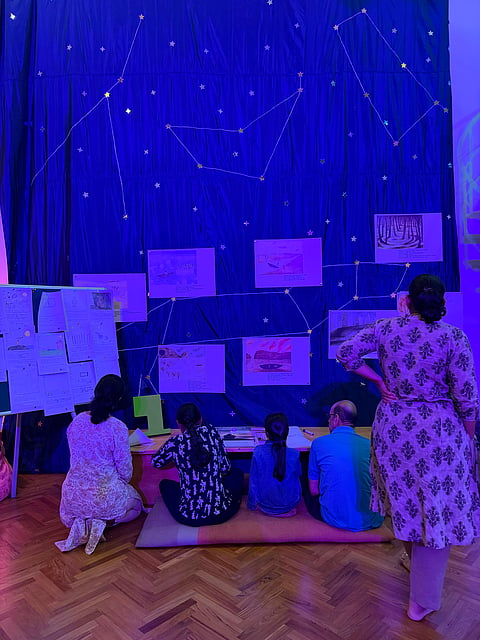
Rhea Kuthoore, founder of Room of Children’s Philosophies in Chennai, along with her team, does just that. Apart from keeping a physical space open in Royapettah for children to participate and have their thoughts fed alongside peers, the forum also works with educators who wish to inculcate philosophical thinking in their students, and with private schools who open their doors for weekly sessions.
The Philosophy graduate says that the initiative tries to take the weight of introducing philosophy off of parents and primary caregivers’ shoulders. “Sometimes it can actually work very counterproductively because caregivers might end up questioning too much and that might not be ideal. Also, if a parent and child have a one-on-one dialogue, it may become intimidating for the latter, which is why we always do this with a group of children. Sometimes it can also lead to indoctrination because parents may think that they are keeping their biases away, but it can very easily slip in,” she informs. Rather than introducing the subject to children through dense texts and complex terminology, they are redirected to tap into the philosophical potential of select children’s literature. Sometimes, they are even asked to play a game, like Snakes and Ladders, “a game of luck except with a twist of choice.” With every roll of the dice, students move and land on numbers where both a ladder and a snake will await them along with a question card.
From her many interactions with students, she recalls a few interesting snippets that left her surprised at their ability to think as deeply as acclaimed philosophers have. “The question we had asked was, ‘What makes a boat a boat?’…While discussing, one child went on to say, ‘I think that what makes a boat is all the parts of the boat.’ That is something that all the great philosophers have said over time, that there is nothing but the parts that make something whole.”
Rhea’s interactions with children have also led her to believe that even though some schools have democratised classrooms by inviting critical thinking, inquiry, and dialogue, the inquiry itself is teacher-led, and oftentimes only encouraged to reach curricular goals. Nurturing inquiry for the sake of inquiry, and discussions that have no right or wrong answers is the goal for Room of Children’s Philosophies. It is also to undo the historical exclusion of children from philosophy and to not treat it as an adult-only intellectual pursuit. “We need to also see what children can bring to philosophy,” Rhea concludes, remaining optimistic about the numerous possibilities that lay ahead.
Upcoming special
With Bachpan Manao, Room of Children’s philosophies is hosting two events for children to philosophise, on November 18 and 19 in Chennai. For registrations and inquiries, contact @roomof_childrensphilosophies