
Maasil veenaiyum maalai madiyamum
Veechu thenralum veengilavenilum
Moosu vandarai poigaiyum pondrathe
Eesan endhai inaiyadi neezhale.
(Like the flawless music of a veena, like the cool evening moon,
like the gentle southern breeze, like the lush blossom of spring,
and like a lotus pond humming with bees —
so is the cool shade of my Father Lord’s twin feet.)
— Appar: 5th Thirumurai
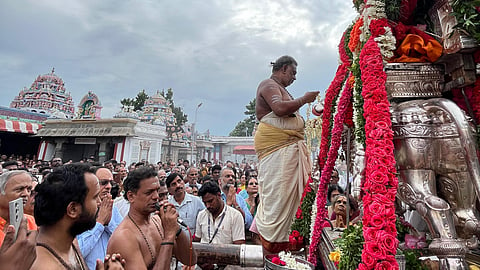
Imagine an odhuvar (chanter) standing between the bustling outer prakaram (where society congregates) and the still garbhagriha (where the divine rests), and pouring his lifebreath into these verses amid the fragrance and glow of dhoopam and deepam.
In those moments of immersion, the odhuvar acts as the living connective conduit between the social and the sacred, for he is the custodian of vak.
Vak is neither a language reduced to worldly expression nor a mere physical sound. Rather, it is the vibrational potency of a thought-state — the bhava holding the semantics (sphota) and sentiment (rasa) of the linguistic and gestural forms. It is the primordial intent encoded into phonemes and meters. In fact, what makes the Thirumurai classical, eternal, and sacred is not its chronological age but this rigorous acoustic geometry — the precise structural matrix that an odhuvar is required to hold and transmit to preserve the vibrational integrity of a language.
That is why, when you hear an odhuvar chant, it transcends language or mere poetic rendition. It shifts the focus entirely onto the listener: how you absorb and process what is evoked. The intensity of your involvement would kindle an acoustic memory pulsating deep within your body, shifting your awareness such that the external chatter would fade. In those moments, any intense listener would feel pulled aside out of the temporal space only to get anchored permanently in the timeless.
In preserving this sublime tradition without chasing the shallow rewards of the modern economy, the odhuvar community acts as living bridges. They are the links within time, that have kept what is “classical” within Tamizhagam from Sangam times — proving that the highest form of culture is not performed, but lived.

Historically speaking, the social roots of the odhuvars trace back to ancient bardic traditions — serving chieftains, kings, and rulers across Tamizhagam showing a strong presence in Tiruvarur, Thiruvavaduthurai, Tirunelveli, and Karaikkal. However, this community suffered severe attrition during colonial and post-independence periods. It was the timely intervention of the adheenams, working in association with the HR&CE department in the 1980s, that made the re-institutionalisation of formal training pathashalas possible. Within this revived ecosystem, B Sargurunathan chose to undergo a rigorous five-year training at Chidambaram, mastering the ancient Pann musical system and the dense, unbroken canonical literature of the Thirumurai. Interestingly, this was also the turn of the millennium, when India was aggressively opening its doors to market globalisation, consumer expansion, and pop culture: when young Sargurunathan made a fundamental counter-cultural choice.
When asked about the economics of his chosen path, he speaks with a quiet poise: “There are no bitter complaints of scarcity because I am well aware that I chose this vocation as a calling and not merely as a career. Does the profession offer fame or luxury? No. Does this profession give fulfilment? Absolutely. Is it easy? No. Would I recommend it to my children? No.”
That final, unvarnished admission exposes a brutal truth and a profound paradox when it comes to sustainability in our cultural ecosystem and the safeguarding of intangible cultural heritage.
Although the latent fragrance of the soil still lingers within our cultural sensibilities, as a collective, our preferences in recreation, leisure, and aesthetics reveal a stark disconnect from our claimed values. The fact is, modern society heavily favours and financially rewards a soft power driven by glamour, spectacle, and aggrandisement — revealing our relationship with heritage to being largely performative.
As a result, the harsh reality is that oral practitioners dwindle as our daily patronage migrates elsewhere, leaving traditions to die of neglect. While culture and spirituality are innate seeds for our existence, we have allowed our daily choices to trap us in a web of profound dissonance. And since this web sustains our urban lifestyles, our immediate cultural ecosystem drives us either into an obsession for algorithmic validation, viral sensationalism, or in frantic pursuit of tangibles alone. We rarely pause to ask: “What are we sustaining as culture for the next generation — material conquest, or living cultural traditions?”
A vow to reclaim the Vak
Looking at the macro picture, this sacred acoustic offering is not an isolated Tamil relic. Across the subcontinent, knowledge architects of ancient times have built an ecosystem as sacred as linguistic acoustic custodians — whether it was the sopanam singers at the sanctum steps of Kerala shrines, the mahari’s offerings in Jagannath Puri, or the kirtaniyas sustained in the monastic sattras of Assam.
Against this backdrop, does Sargurunathan’s path not demonstrate that anchoring oneself in the sacred is a choice to live in the present and feel absolute reality? Does he not stand as a living testament that true liberation comes not from chasing external abundance, but by tuning our internal resonance? Clearly, his choice is neither a demand for performative altruism nor a call for romanticised austerity. It was a conscious, rational path to sustain the living roots that nourish our spirit.
If heritage is not to vanish into a vacuum — if culture is to sustain — then society cannot merely claim these lineages as passive points of pride. How can they be integrated into your everyday choices?