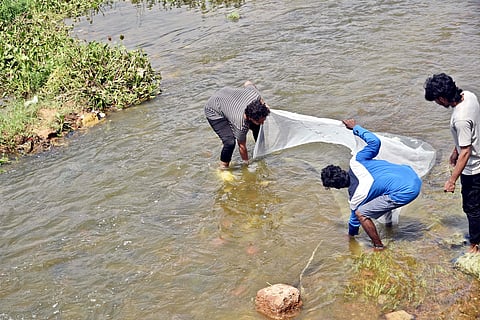

For a coastal city like Chennai, fishing is hardly an unfamiliar sight. It is woven into our ooru’s very fabric. The fresh catch displayed in markets, fishing nets spread out to dry alongside our shores, boats anchored on beaches, and even the occasional smell of fish at railway stations — a reminder of the trade that carries Chennai’s catch to markets within and outside the state — talk of how deeply fishing is embedded in our everyday lives.
Yet, while marine fishing continues to shape the city’s markets and eating habits, inland fishing, practised in Chennai’s many lakes and canals, continues to be pursued by smaller communities of fishers on the peripheries.
And as for the working-class people — beyond the fishing community — who continue to live around these waterbodies, inland fishing during the monsoon, when lakes and canals swell with rainwater, serves them in more ways than one. Although these enthusiastic fishers can be found across the city, including in the Buckingham canal and Adyar river, a quick stop at the many waterways that connect to the lakes located in North-West Chennai (Korattur and Retteri lakes) tells stories of livelihood, sustenance, and leisure.
For the migrant workers, nestled in small quarters in and around Ambattur Estate’s many factories, fishing in canals means an additional source of income. Kailas Kumar from Uttar Pradesh says, “We catch ‘colour’ fish (aquarium fish varieties). They are small and come in bright colours like orange, yellow, and red. They are difficult to catch, but for one ‘colour’ fish, some stores (pet shops) pay Rs 50-Rs 70.” As aquarium fish are fewer in number than native species, they wait for long hours and release native fish breeds if caught. “We don’t cook and eat fish in our room,” he adds, claiming that it takes several hours for him, along with his colleague from Haryana, to catch enough ‘colour’ fish to make between Rs 200 and Rs 500.
His colleague Rithesh Dhobi confesses to only finding time for fishing on Sunday mornings. “I have to send money home every month and not much stays in my hand during month ends. So I try my luck with fishing to make extra cash,” he shares. And what do the two men do with the extra money? They smile and declare, “We will buy biryani and eat.” An indulgence to relish after a week of doing their physically demanding jobs at factories.

Their fishing equipment is simple and largely handmade. They fashion their fishing rods from long, slender tree branches,to which they attach a fishing line and a hook bought from a store. They even source the bait locally by patiently searching the moist soil for worms along the canal’s banks and edges.
On Korattur’s Eri Canal, Vadivelu, a lorry owner and driver, fishes with the earthworms and larvae he sources from a local cow shed. “We find worms and larvae in cow dung that attract many local fish species when used as bait,” he says, pointing to a small plastic paint tin full of bait. His fishing equipment is even simpler — just a fishing line with a hook at the end.
Fishing with similar apparatus is Raja, an auto driver, who Vadivelu says is the most passionate among the local group of fishing enthusiasts. “I have always loved fishing. I have lived in this area and have been fishing since I was a boy. Whenever I find time, I come and fish. On festival days and holidays like Sundays, I do not drive. I come to fish,” says Raja, who drives for leading ride-hailing platforms in the city.
Unlike the migrant workers, these men catch fully grown fish, for consumption. One particular species they call ‘naatu jalebi’ (tilapia) dominates their basket. “Its taste is unmatched. Look at its skin,” Raja urges, pointing to the fish’s greyish white scales.
Vadivelu, meanwhile, rationalises, “We have to spend somewhere between Rs 500 and Rs 700 to buy big fish for cooking at home. Eating this is more economical. It is also tasty, some will even say this tastes better than sea fish.” And on days when they catch more than enough fish, they confess to giving away the excess to anyone who asks. “We will sell two or three fish for Rs 200,” Vadivelu says.
Although sewage water mixes into the canal, the men claim that adequate cleaning makes the fish safe to eat. To avoid falling sick, they refrain from fishing during the non-monsoon months as the lake dries up, leaving only sewage to flow or stagnate. But when it rains, especially during heavy spells in November and December, lakes overflow and release both water and big fish into canals. “During cyclonic rains, we catch fish weighing as much as 5 kg or even 7 kg,” Raja says.
Apart from these two, some others also pursue fishing as a hobby. Lakshmanan, Raja’s uncle, a construction worker, too, participates in the activity. “It is a very cheap hobby. I just spent Rs 150 on the fishing line which I have used for many years. I only change the line if big fish slip out. It keeps me occupied and relaxed,” he informs.
Lakshmanan teaches Monish, a 13-year-old, to properly attach the bait to the hook. The class 8 student imitates him to catch smaller fish that he intends to grow in a small pond outside his home.
When asked why women from their homes and neighbourhoods weren’t partaking in this hobby, the men unanimously declared that women were “disinterested.” “They cook the fish but don’t wish to come out and fish,” Raja dismissively remarks, denoting a similar gender divide reported among the city’s marine fishing communities.