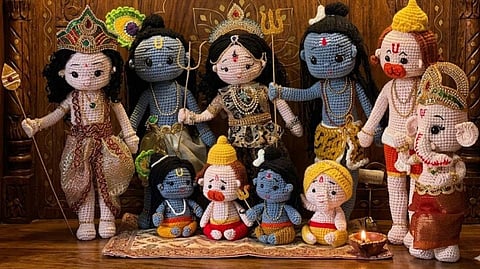

The familiar sights of Golu padi, the aroma of prasadam, and the colours of Navaratri’s enduring charm are here. Over the years, the dolls that occupy the odd-numbered tiers in households have evolved in material and form — from clay figurines and marapachi bommai to terracotta, papier-mâché, and eco-friendly alternatives.
Crochet dolls have entered the scene this year. For many artists practising this craft, it began as a hobby with a hook and a ball of yarn, and eventually became a way of storytelling and display of the divine. City-based artist Shana’s (@s_baby_craftyknots) journey of making crochet deities began with encouragement from another artist, Vivek Vaid of The Sunflower Ladies. “The opportunity he gave to create dolls of gods in crochet became the starting point for us to explore how our traditional gods and goddesses could be represented through handmade crochet art,” she says about bringing her passion into making traditional dolls.
While experimenting with different deities, their costumes, ornaments, and colours, she ensures the traditional essence and identity of each deity is maintained. Meanwhile, for Dharshnaa Karthikeyan (@catty’s_corner) from Tiruppur, the idea of creating crochet deities emerged from the absence of the Tamil kadavul in the market. “I had a major surgery lined up, and I wanted to take something with me to the operation theatre or to have during the recovery. I’m a Murugan devotee, so I searched through various platforms like YouTube and Reddit (for ideas), but I found out that there are no exclusive patterns for Murugan,” she says. Instead of giving up, she decided to create her own pattern. From Murugan, she moved on to Vinayagar, Krishna, Lakshmi, and Saraswati. Dharshnaa recalls her first crochet order from an NRI family who were looking for something durable and travel-friendly to beautify their foreign home for the festivities.

Delhi-based Prerna Kataria (@thedodocrafts) discovered crochet two years ago. As her work gained attention online, she started developing her own patterns. One creation, Bal Bajrangi, received around a million views, opening the door to commissioned work. “A customer from Kerala asked me to make 15 deities, which included deities from different regions and cultures, for a Golu competition,” says Prerna. Following the virality, she has shipped the crochet deities to Canada, the US, the UK, Australia, and others.
Creative exertion
It is the details — Shiva’s trishulam, vibuthi, tiger-skin attire and crescent moon, or Krishna’s peacock feather and pulanguzhal — that bring each deity’s identity to life. From intricate jewellery and elaborate costumes to crowns and accessories, every element involves careful planning and precision. The artists price their creations according to the size, materials, and detailing involved, which can range from Rs 500 to Rs 3,000.
Beyond the creative effort, the dolls offer an advantage that traditional dolls rarely do. Prerna notes, “The deities are made using cotton yarn, making them a more sustainable option. They can be washed and reused instead of being discarded when they get dirty. They can also be displayed in puja rooms or as home décor. Each piece is a work of art that can be preserved as part of a collection.” Shana adds that since they are handmade, damaged parts can often be repaired.
Yet, the value of handmade work is not always reflected in the price customers are willing to pay. Dharshnaa adds, “Customers often offer to buy the yarn for the doll, but the time and skill that the artist puts in are always being overlooked.”
Blending old and new
New ideas do not always find acceptance, especially when it involves religious figures. Dharshnaa has been questioned about her caste in connection with making the deities. “There are some who admire but do not buy it and bring that crocheted deity to their home because they are set in their ways. We need to grow a lot in that sense,” she says.
The growing popularity of amigurumi, the Japanese art of crocheting or knitting small, stuffed figures, could offer a new avenue for the craft to find wider acceptance. Prerna believes the technique has recently gained visibility in India, with social media introducing more people to its possibilities. Shana says, “I believe this is also a wonderful way to introduce younger generations to traditional practices through a craft that feels modern, creative, and relatable to them, while respecting the cultural significance of Golu.”
While crocheted dolls may not replace the conventional ones, artists believe it offers families another way to interpret and personalise their Golu displays.