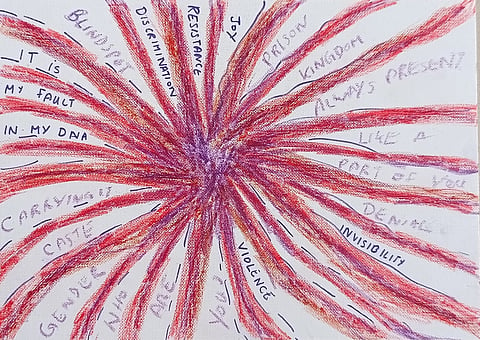

Shame. Guilt. Rage. Silence. Deserve. Worth. Spit. Smell. These words are scrawled across a paper amid silenced face sketches and earthy colours. This fragmented vocabulary may at first seem blunt. But together, they begin to trace the emotional terrain of caste — the feelings that are often pushed to the fringes.

There is anger, grief, questions of belonging and worth, and the quiet ways in which caste can seep into how people see themselves in this world. Creating a platform to bring this deeply personal terrain, expressive arts therapist and theatre practitioner Pallavi Bhanothu (Thespian Therapist) and psychotherapist Ria (Slow Ferment With Ria) initiated Our Letters to Caste (OLTC), an “anti-caste interactive experiential performance and workshop” focusing beyond simply talking about caste to asking how it is felt, experienced, and expressed.
The initiative began in August 2024, when Pallavi and Ria, who are based in Hyderabad and Kolkata respectively, read letters they had written as part of an assignment for an Anti-Caste Mental Health Practices Diploma. OLTC began as an attempt to recreate that experience of sharing their stories with others, which gradually grew into an online workshop. Held over three hours, the first 45 minutes are devoted to the organisers’ letters. The two begin by setting ground rules and creating a space where participants can engage with a subject as heavy and vulnerable as caste while taking care of themselves and one another. They then read their letters and hold space for responses before shifting from performers to facilitators and participants from “witnesses” to active contributors.
“For me, caste is something that is never discussed. There is no space where caste can be talked about. Not schools, not companies, offices, and definitely not homes or neighbourhoods,” says Pallavi. That absence of space is also why the duo chose an interactive format. By sharing their own letters first, they seek to unsettle the conventional power dynamic relationship between facilitator and participant by “being vulnerable ourselves first and that way we are not the fully sorted ones who get to see people’s tears or pain”. She stresses that not just the facilitator, but everyone holds knowledge.
The second half incorporates activities. Democratising the space, as Ria terms it — while participants speak, paint, write poems or a few lines, or create something, the facilitators take upon the role of witness.
The workshop makes room for silence too. Participants are not compelled to speak, move or keep their cameras on. Silence, Ria says, can itself be a way of taking up space and sitting with feelings, memories and discomfort. “All emotions are welcome. Anger is also welcome. But we try to be mindful of how we express anger,” she says.
Their go-to question to keep the conversation alive is classic: “What question do you want to ask caste?” And the duo says that they have received answers like, ‘Caste, when can I have a home of my own?’ ‘When will you self-annihilate yourself?’ ‘How sly are you?’
It is this attention to emotion that the duo notices is lacking in conventional conversations. Pallavi observes that these conversations often fail to accommodate shame, disgust, loneliness, grief, guilt, and gratitude.
Ria points to the tendency to discuss caste through “reservation, honour killings, news items or the question of a caste census”, while overlooking its everyday presence. She opines that feelings are the one place where caste really registers. “Feeling acts as information that caste actually does something to us, because otherwise there is denial that there is no caste or caste is a thing of the past. We repeatedly say feelings, emotions, body because that is what gets unnoticed the most,” she says.
A brave space
After seven editions, she says, the uncertainty remains, as does the vulnerability. “Vulnerability begets vulnerability,” Ria says. Vulnerability is deliberately built into the process. Pallavi observes that it is often reflected in a protective form where the participants often share something and punctuate it with a statement like, ‘I’m just scrambling’ or ‘I’m not being coherent’ or ‘I’m all over the place’.
The space nudges participants to look beyond the binary of oppressor and oppressed and examine how caste is internalised. “It also psychologically and emotionally resides within us. It is that powerful. So, somewhere the work has to start within ourselves,” Ria stresses.
The process is not only about pain. Pallavi highlights moments of silliness, pleasure, desire, and joy — spaces to imagine a life not controlled by caste. When participants are asked what they want to continue exploring, their answers include removing the practice of using surnames, reading Dalit literature, exploring artists from marginalised communities, and having conversations with family members. The intention, Pallavi says, is not to provide closure but to keep the conversation alive.
Adding to the major takeaway the participants get from the workshop, Ria says, “We are exhausted — from life, socio-political happenings, rehearsing, thinking of new ideas. We are also bringing that exhaustion to the workshop, and we are certain that the participants are already doing the same. At the end of the workshop, they find space to express it. They take up that space and say, ‘I'm just exhausted ’, and at the same time, the workshop makes them feel held.”
And OLTC leaves its participants not with an answer, but with questions about caste, and the space to sit with it.