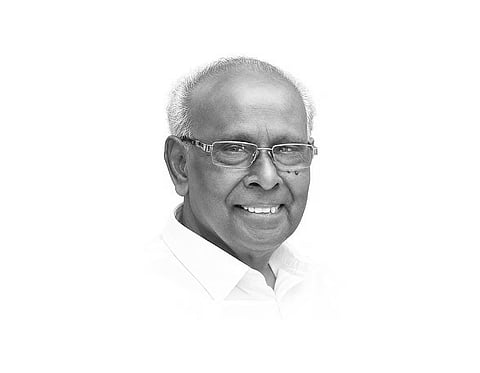

For generations of Tamil households, no Pongal, Tamil Puthandu, Deepavali, Ayudha Poojai, or Vinayagar Chaturthi was complete without Solomon Pappaiah’s familiar voice ringing through the television: “Anbu periyorgale, arumai thaaimaargale...” With humour, simplicity, and an unmatched command over the Tamil language, the legendary scholar and orator transformed the pattimandram from a platform for intellectual discourse into a conversation that reached everyone.
His debates became a festival ritual in themselves, bringing families together for a couple of hours to engage with questions of feminism, equality, generational change, matrimony, money, education, technology and whatnot. But beyond the laughter and witty rebuttals was a style of debate that encouraged audiences to listen, think, and disagree without disrespecting the person on the other side.
Following his demise, and as his last show as a host airs today, CE talks to fellow pattimandram debaters, public speakers, and those who grew up watching him as they reflect on the enduring legacy of Solomon Pappaiah and what his art of speaking can teach a generation growing up amid instant opinions and social media debates.

Bharathi Baskar, banker, debater, and author
My supreme learning from him was the effort he put into his speeches, writings, and every work he undertook, especially for the marginalised. He believed in simplicity. Just about one-and-a-half years ago, he donated about Rs 20 lakh to the school where he studied because the building of the school collapsed. I last met him on September 5 to shoot for the latest Pattimandram, to be aired on Monday (today). He was so agile, jubilant, and humorous that day. He was very alert on stage, and the topic was related to Gen Z, and he gave a verdict in favour of the kids. Usually after the recording is over, we go for dinner together. That day, he was surrounded by so many people, and there was a crowd gathered around me too. So, we were unable to see each other after the filming. I never thought that was the last time we would meet, and I did not say goodbye to him. I am still not able to understand how or why this happened. He lived such a magnificent life that ended in a magnificent way. He made the pattimandram art form popular. Before him, it was present only in literary circles and among those who had the opportunity to study literature. Solomon sir was the first one to introduce family topics in the show, resulting in more women’s participation in debates. Only after that was done, the art form became the art form of the people. He was there in every house, and people took his judgments very seriously. So he reached everywhere, and it was because of him that this art form is so widespread and has reached the heights that it currently is.
S Raja, debater
I first met him in 1976. At that time, I had joined American College as a student, and he was my professor. I used to be around him and would often assist him in whatever way I could. I developed a great interest in his way of speaking, and I wanted to become a speaker myself. I was very fond of him because there is so much that I learnt from him. He was extremely organised and meticulous. He knew exactly where every book was in his library. He had an incredible memory. He preserved invitations from nearly 60 years of events he attended, arranging them chronologically. Whenever he went to an event, he would prepare detailed notes about the subject and read them out; if necessary, he could speak from memory. He never seemed to run out of things to say. He had spent nearly 66 years on stage, yet he continued to approach every occasion as though it were something new. Even in his last debate, he remained a student, constantly learning. If you go to his house, you will see the chair where he has spent so much of his time sitting and reading. He would always have a book in his hand. He always had an enormous appetite for reading. He was also a very talented artist. He could draw beautifully. He had a very good voice and sang with great clarity. He wrote poetry sometimes. When we talk about pattimandram, he was someone who truly believed that there should be no inequality in society. There should be no exploitation, hunger, or poverty. He tried to help people in whatever way he could. He did not believe that one should live with the desire to accumulate wealth. Instead, there should be a willingness to give and help others.
Ramkumar Natarajan, stand-up comic
I have shared the stage with him on a couple of occasions. One instance dates back to my college days during my final year at the Government Engineering College in Tirunelveli. We invited Solomon Pappaiah as the chief guest for a debate under his moderation; I was one of the speakers. He encouraged me immensely, both on and off the stage. Whether it was the introduction he gave me before I spoke, or the way he praised my performance, he was incredibly supportive. Honestly, I still consider that specific moment a defining one in my journey as a public speaker. Later, I met him in 2022, 16 years later, when I was invited for a television pattimandram moderated by him. No matter the topic, be it Tamil literature, religion, or anything else, he could speak for hours on stage. He could even speak without any preparation. That level of ability is remarkable; for someone like me, speaking for even half an hour without preparation is a huge challenge. He could handle any topic without ever hurting anyone’s sentiments. He always spoke without offending, and that approach — being a voice for the voiceless and ‘punching up’ rather than down — is a principle he has followed for a long time. The key lesson is that we must be a voice for those who cannot speak for themselves. Many of his judgments reflect a positive, progressive outlook. When we discuss something, he would never simply pass a negative judgment. His perspective was always to look at things with a positive outlook; he would invariably see the good in everything. This is something every generation should take away from him.
Muthukumaran Jegatheesan, public speaker and video jockey
My journey started with elocution contests and pattimandrams in school. For us, ayya was the ultimate role model — we aspired to speak just like him. You know how he would start with ‘Arumaiyana periyogale...’ It was so natural; he possessed that unique language that seemed to touch common man. He transformed the pattimandram by bringing literature down from high-brow settings to the layman and took the ethical wisdom found in it directly to them. He demonstrated that oratory should belong to the common people. Whether among public speakers or the general public, we tend to view ayya primarily through the lens of a debate speaker. He played a monumental role in taking the art of the debate show to a global stage and connecting it with Tamils all over the world; for that, he deserves our deepest respect. I would encourage anyone with the opportunity to listen to his speeches on literature as well. He served as a Tamil teacher and possessed vast, profound literary knowledge. You may have seen him displaying great humour on debate stages, but he was also a man of ‘rowthiram’, a trait often found in those deeply committed to the Tamil language.
Saroruha R, student and articled assistant
One aspect of his debating that everyone would find striking is the level of humour. His debate often feels like a conversation that allows an idea to be explored deeply rather than a battlefield that tries to diminish the opponent. Something else that I truly admire is his patience to listen and to ponder and then respond. His greatest rebuttals are often humorous and simple but have the power to make people reconsider and question what they believe in, and I consider that the biggest win in a debate. I believe, while we have become mindful about the language that we use, we have also somewhere become afraid of disagreement. Disagreement can and should exist independently of discrimination. Political correctness and empathy should go hand in hand. Change in someone’s worldview should be considered success rather than just winning the debate. With the increase of opinions being expressed on social media, there is often an invisible pressure to already have an opinion or stick to an opinion. The thought of making an informed opinion has become inferior to actually having an opinion in the first place. A thoughtful debate could only occur when I am able to understand where my opponent comes from.
ARA Bowthan Ajith, poet
I never had the opportunity to meet Solomon Pappiah sir. But his voice and his way of speaking have been a part of our generation for a long time. I am also one among those who grew up watching his pattimandrams and listening to his speeches. What impressed me most about his style was the way he could present even complex ideas in simple Tamil, with humour, and make them accessible to ordinary people. More importantly, he had the ability to debate an idea without treating the person on the other side as an enemy. In my opinion, social media has increased the speed at which we respond more than the speed at which we think. Today, it has become common to respond immediately without completely reading or understanding what someone has said. Because of this, the patience to listen, understand an opposing view and then respond thoughtfully has reduced in some spaces. Those of us who grew up watching his pattimandrams learned that a debate is not merely about winning. It is about listening, thinking, and expressing an opinion with dignity.