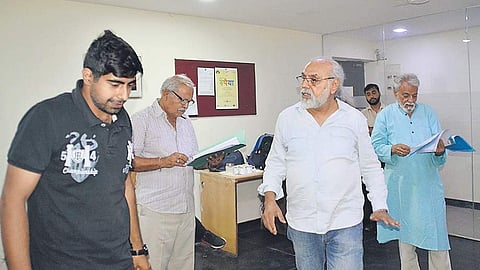

40 years ago, it was performed to a packed audience and a standing ovation at Kamani auditorium. This affirmed the success of Makhichoos, before it was rechristened to Rupaiya four decades later. Director Kanwar Deepak Gulati brings back the famous play with a few twists. Gulati’s association with the play goes way back when he an assistant director to the then director late Ravi Vaswani.
Adapted from the popular French comedy The Miser, Rupaiya highlights the permanent culture of greed that runs through the veins of people, societies and the world today. There have been several adaptations of this five-act prose by the French playwright Jean-Baptiste Poquelin also known as Moliere, since it was first staged in 1668. Baswani’s version added another layer to the bouquet of interpretations. Rupaiya is thought-provoking without being priggish.
The new adaptation has cast veterans such as Maneesh Manoja as the miser protagonist, in addition to other senior actors such as Subhash Tyagi who plays a cocky servant, to new actors including Nikunj Wadhawan playing the main lead’s son, and Manthra Mausi who is forges matrimonial alliances.
The play follows Lala Dhannamal who is obsessed with accumulating wealth without squandering a penny. Even as a nonagenarian widower, he fancies getting married to an attractive young woman. Co-incidently, his son works on securing a loan for the same girl whom his father wants to marry.
On a separate note, Dhannamal hopes to wed his daughter to a monied man of his choice, knowing little that his daughter’s lover has started working in his house under the guise of a steward so that he can remain close to his love. “These various situations come together in satire and farce giving you a riveting, fast-paced story. In the middle of all this, Dhannamal’s box of gold coins gets stolen adding to the confusion,” says Gulati, who has kept the comedy subtle. An emphasis has been given on underplaying, as opposed to overplaying.
Despite being a seasoned theatre and film practitioner, he still feels anxious going ahead with this play. “People have great expectations from it. It has a legacy that I must honour,” he says, adding, “I’ve followed the footsteps of my friend and the actor the late Baswani, who directed this play in a democratic way. Likewise, I haven’t imposed myself on any cast member. I have first allowed them to perform a scene their way and then improvise if required.”
Slightly discontented by the way plays are being viewed today, Manoja feels frustrated about theatre being viewed as a source of just entertainment. June 15, at 7 pm, Little Theatre Group, Mandi House.
