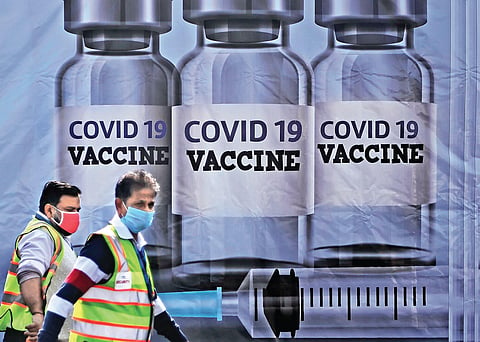

In July, Dr Saurabh Nanda, a consultant at the Covid-19 ICU ward of Medanta Hospital, was bedridden with the virus to become one of the first to be infected among his colleagues at the hospital in Gurugram.
In November, Nanda had to be shifted to the hospital’s same ICU ward as he caught the virus a second time. Despite the suffering, Nanda returned to work soon after his recovery.
“But there is always the risk of getting infected again,” the healthcare professional says.
Encouraging results on Covid-19 vaccine trials by frontrunners in the recent past have come as a huge relief for Nanda and thousands of frontline workers in the city as they will be administered the first generation of coronavirus antidotes, likely to be rolled out in January next year in the country.
“There are many vaccine candidates which are awaiting the final approval from the Central Drugs Standard Control Organisation (CDSCO), while some are in the trial phase. We, healthcare workers, want to see vaccines that will have maximum immunity with minimal side effects. India is densely populated and hence, the vaccination drive has to be done in stages. I am hopeful for the best. Until then, all precautions like wearing a face mask, maintaining social distancing, and using hand sanitisers should be taken by everyone,” Nanda says.
Last week, Chief Minister Arvind Kejriwal unveiled the state government’s mega Covid-19 vaccination plan, saying his government was prepared to receive, store and provide vaccines to the priority category persons in the city.
He also said there were 51 lakh people, including healthcare and frontline workers, who will be inoculated in the first phase.
When the pandemic first hit the city, 51-year-old Sarita Thapa, a resident of Mayur Vihar, had also become its victim. Her son, Samarth Thapa, breathed a sigh of relief when the Centre announced that vaccines will be rolled out in India as early as January next year.
“I was elated by the news that the vaccination process would begin soon. We had a really difficult time when my mother got infected in June. She had to be admitted to a hospital that was itself a daunting task at that time. There were hardly any beds available then. My parents are above 50 and since there are always chances of re-infection, vaccines appear to be the only ray of hope to overcome the pandemic... . I am waiting for the government to roll out the vaccines,” says Samarth.
However, apprehension among people regarding getting vaccinated for also appears to be rising.
Recently, the AIIMS-Delhi had reported that it was struggling with the volunteers who were to be examined for the third round of Covaxin clinical trials — an indigenous vaccine produced by Bharat Biotech in collaboration with the ICMR.
The hospital is one of the centres conducting the final phase of the trials and it needs around 1,500 volunteers for that.
According to a doctor at the hospital, people are reluctant to participate in the exercise thinking why to take part in a trial when a vaccine would be available soon for everyone.
Even for the authenticity and side-effects of vaccines remain a big worry for residents. Rakesh Shukla, a government employee residing in Vasant Kunj, says he is not rushing to get his father, 72, and mother, 66, to get vaccinated in the first phase there is no clarity on how effective the vaccines would be.

“It takes around 10-12 years to get a matured vaccine. Also, there are multiple vaccines which are being talked about. But till now, no vaccine has claimed that said it has 100 per cent efficacy. See what happened to Haryana’s Health Minister Anil Vij. For the safety of my parents, I would surely like to get them vaccinated, but since it is voluntarily, I will not force them. We want to wait for a few months to see the results,” says Shukla.
However, according to health experts, while vaccines developed previously have taken years and even decades to be approved for use, the Covid-19 vaccines needed to be developed and approved in a fast-track manner.
Just because it has been fast-tracked, does not mean it has been rushed. All vaccines approved for use as of now have gone through the clinical trials phase, and have proven safe and effective.
Rita Sharma, 62, a retired teacher of a Delhi government school, says she full faith in the scientists developing the vaccines. An optimistic Sharma says: “Misconceptions and myths circulating around can convince you to not get a vaccine. We cannot defeat the pandemic with such an approach. It is a mammoth task undertaken by the government, providing a vaccine to approximate 2 crore people, even in a phase-wise manner, is not easy and as a citizen, we need to support the government.”
Hauz Khas resident Pallavi Singh’s uncle, Vinay Kumar Singh, a senior citizen, had also tested positive for the deadly virus and was admitted to a city hospital.
Despite some appreciations, Pallavi, a painter, says she has no other options but to rely on the vaccines to remain safe.
“My uncle was physically fit. He does yoga every day. When he got infected and had to be put on a ventilator, we all were really scared. It was perhaps the most difficult phase for our family. Thus, I don’t want to that phase again. My family will definitely apply for the vaccination,” she says.
How will vaccination work?
Each person in priority categories is being registered to receive the vaccine. They will be informed through SMS and other means whenever their turn for vaccination arrives.
The necessary staff, officials and health workers have also been identified and trained for the vaccination drive.
The sites where vaccination will be carried out is also being readied. Arrangements are being made on behalf of the government to identify and mark sites and locations across Delhi, where these vaccines will be administered.
“We have sufficient locations with us. The manpower and the number of teams that we require for the administration of the vaccine, such as officers and workers have been marked and they have all been trained for the task. Each team will have five people,” Kejriwal had said last week.
The Delhi government has made proper arrangements for the treatment of such patients such as the arrangement of doctors and adequate treatment methods, just in case there are some post-vaccine side-effects on a person.
However, when this correspondent spoke to some residents they said the Delhi government was yet to approach or contact them for registration for the vaccination process.
“Till date, I have not received any such calls nor anyone whom I know in my circle, who are all above 60 years,” says Sunil Sarda, a sexagenarian.
‘Educating people a challenge’
Dr Lalit Kant, former scientist ‘G’ and head (epidemiology and communicable diseases division) at the ICMR, said the Indian drug regulator may give its nod to AstraZeneca’s vaccine first among others.
But the main challenge for the government will be to reach out to the mass, maintain the data and ensure that they get both the doses.
“The storage of vaccine is not the main concern but educating the public to take it on a priority basis. People are not getting confidence in the efficacy of the vaccine... Also, the government needs to come out about the whole process — how the data is being collected, how the residents will be contacted, among others,” says Kant.
Firms at the forefront
Covaxin
A product of ICMR-Bharat Biotech collaboration. Third round of trials on volunteers are being conducted at AIIMS.
95% Pfizer-BioNTech vaccine
It claimed to be 95% effective against Covid-19. Its efficacy was consistent across age, gender, race and ethnicity demographics; observed efficacy in adults over 65 years of age was over 94%. Safety data milestone required by the US Food and Drug Administration (FDA) for Emergency Use Authorization (EUA) has been achieved.
Moderna vaccine
The company said the vaccine it is developing has registered 94.1 per cent efficacy in trials on 196 cases. An earlier interim result, announced on November 16, based on analysis of trials on 95 patients, had shown an efficacy of 94.5 per cent. The vaccine efficacy against severe Covid-19 was 100%.
92% Sputnik V
Russia said Moscow will jointly produce the vaccine with New Delhi and it will be manufactured by Indian pharma major Dr Reddy’s Laboratories. The vaccine has shown 92 per cent efficacy in preventing Covid-19.
Oxford–AstraZeneca vaccine
The vaccine, which also has a tie-up with the Serum Institute of India, ‘should be’ effective against the new strain of the virus, a UK media report said on Sunday.
AstraZeneca’s chief executive Pascal Soriot said new data will show the vaccine is as effective as the Pfizer and Moderna jabs that have already been approved, protecting 95 per cent of patients, and is ‘100 per cent effective’ in preventing severe illness requiring hospital treatment.
How many cold chain points in Delhi?
609 cold chain spots identified in the national capital for the storage of the 74 lakh doses. The capacity will be increased for 1,15,00,000 doses.
Cold chain points
Places where vaccines to be given
Storage facilities
At Rajiv Gandhi Super Speciality Hospital, there will be 90 freezers, many of which have already arrived.
The identified cold storage facilities are equipped with deep freezers, refrigerators, walking coolers, vaccine carriers, and thermocole carriers
As the country prepares to roll out Covid-19 vaccines, Delhi govt says it is ready to receive, store and provide doses to priority category persons. Despite experts assuring that all vaccines have gone through clinical trials phase, many are sceptical about their side-effects, reports Somrita Ghosh