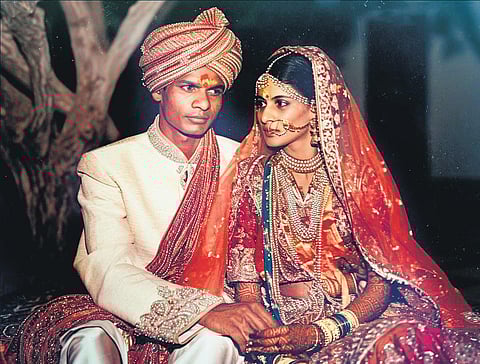

Meet Madhav Kohli, a 25-year-old, Gurugram-based AI artist known for his digitally created ‘realities’. His latest work, ‘Aapke mummy papa ki shaadi’, is an AI art series reinterpreting ’90s wedding photographs. His parents’ wedding CD was what set him off. What if he could arrange stills from other weddings, or photos of complete strangers, and put together a wedding he had no chance of being part of? “And what can be more nostalgic or more evocative than the wedding of one’s parents? None of us can be part of that, and yet we wish we could have been there…,” he says.
An experimentalist
Kohli has been drawn to digital art from his teenage days. He initially started with Photoshop; he would edit different photos to turn them into one. Later he also tried his hands at different photo-editing platforms, including VQ-GAN (in 2021) – one of the first text-to-image generators that yielded disappointing results. He kept at it, until he discovered Midjourney, an open AI text-to-image generator. His experiments with it led him to his first-ever viral AI art series in 2023 — for example, he fed stereotypical descriptions of what a girl from Delhi could look like on Midjourney, and then did so with people from different states. Kohli was invited to the Vishwakarma Institute of Information Technology in Pune for a TED Talk soon after; there he met some young and talented minds with the same search.
They went on to become part of his virtual studio, Madoli Creative, which he founded in April 2023.
Ever since, he has not looked back. He has also collaborated with Lenovo in December 2023 for their series, Brave New Art, where they feature tech-savvy artists and their new creations.
“AI has democratised art; it is no longer an exclusive club,” says Kohli. And he may be somewhat right; more and more people with AI software such as DALL-E or Stable Diffusion are creating art that is just a click away.

Past perfect?
“I focus on Indian aesthetics and storytelling about people like you and me,” says the artist. His artworks capture the essence of ordinary lives, nothing fancy or unreal, but moving. Instead of imagining what it is like to live in the future, Kohli reimagines the past — things that have happened, but might not have been documented -- with today’s digital tools. For instance, his series on stereotypical men and women from different states or how Indians stereotype people from different countries, the series on powerful rulers of India, and his recreation of old civilisations of South Asia, including the Indus Valley Civilisation, Hampi, and so on. His wedding series, which he put up recently, have created quite a buzz, perhaps due to this being a wedding season.
Wedding photos
To recreate photos reminiscent of ’90s weddings, Kohli studied wedding photos over time. “Apart from photo quality, there are substantial changes in the subjects themselves. Contemporary wedding fashion, for example, is sophisticated and streamlined,” he notes. In contrast, earlier weddings, as he points out, displayed diversity in clothing, jewellery and decor. Brides wore vibrant colours and heavy jewellery; many brides went without heavy makeup. In older photos, acne was not visible, he adds tongue in cheek. “It’s not that people did not have acne back then; it’s because the cameras were not capable of capturing it.”
To make the photos look like they were taken in the ’90s, Kohli mentioned certain technicalities in the prompts such as low aperture, bad lighting, and poor framing. When it came to the texture of the image, he asked that it be grainy and specified the use of a flashbulb camera. “Sometimes you need to use negative prompts to get the best results,” he says. The fun part about Kohli’s wedding series is that it not only focuses on the bride and the groom but also captures the true spirit of desi weddings. “I wanted people to look at the photos and think, ‘Oh, yes, this always happens,’ when they see pictures of people at dining tables. The photographers always captured people eating, and that was the most awkward, yet fun part of those weddings,” he says.
Work in progress
The process of art, whether through AI or not, is always a work in progress. “The more you create, the better you get. AI always messes up the hands, limbs, proportions. It produces better images of women because it is trained on a massive dataset of internet pictures, and since women were heavily photographed and drawn, more photos of women are available online compared to men,” he says. However, with time and more software updates, these issues will be resolved, he says.
While art is a medium of expression and AI is just another tool that facilitates this expression, Kohli is positive that this marriage between tech and art will be a fruitful one. “People were as angry with a camera capturing beautiful landscapes, as they are now with AI, but it is important for art to keep evolving, so that more and more people can express themselves,” he says. “Art has always evolved with technology.”