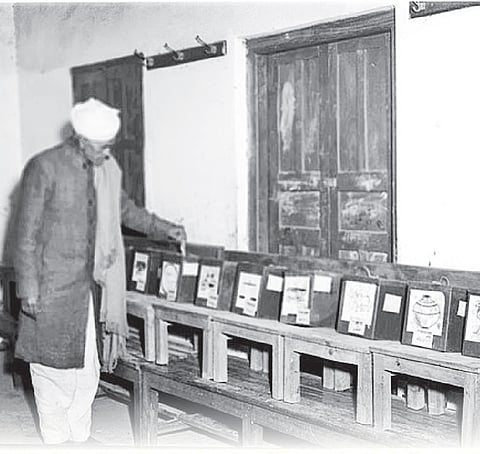

In 1957, between February 24 and March 14, a peculiar scene unfolded at polling stations across India. Voters, eager to cast their ballots, arrived with offerings of vermilion, flowers, and even chits containing requests (as done in temples) or money for the ballot boxes. This unusual display of reverence for ballot boxes is captured in a 1957 report by the Election Commission of India (ECI), which notes: “Petals of flowers dusted with vermillion were left upon a few ballot boxes, indicating that some voters had regarded the ballot boxes as objects of worship.”
Fast forward to the present, and India just finished the third phase of voting in its 18th general elections. In a significant shift, female registered voters now outnumber male voters by 15 per cent, notes the Special Summary Revision. This change reflects how far we have come as a nation—a story that Delhi’s Election Museum tells. With 1.85 crore first-time voters, who can learn about the history of elections in India, it makes this museum especially worth a visit now.
Located in the building that once housed the St Stephen’s College, now part of Delhi’s Chief Electoral Office, the government-run museum was established in October 2016. It archives the evolution of elections in India, offering a glimpse into the country’s democratic journey. “It took roughly two years to renovate, organise the archives, and finally curate the galleries,” says Mukesh Choudhary, senior assistant and museum in-charge. The galleries are also updated after every election, he says. “After this election, too, we will go through the data and add it to the gallery,” he says.

Ballot boxes to EVMs
Ballot boxes from 1952—the year of India’s first general elections—to 1993 line the corridors. “The first election used a smaller ballot box compared to the elections that followed. Most of these boxes were, however, made of steel during the first elections, only Madras used wooden boxes, probably because that was easily available there,” explains Choudhary. For the 1952 elections, 12 different steel boxes were sanctioned, but only five were chosen by the state governments. The names of the designers who made these ballot boxes in the first elections are also on display.
“In the first election, each candidate was assigned one ballot box. But that changed, and by 1957, one ballot box was assigned to two candidates. Then by 1971, bigger ballot boxes were used without assigning any of them to a particular candidate. Once the voting was over, the boxes were tied with silk ribbons and knots were sealed,” says Choudhary.
The task of counting of votes was painstaking. However, with the introduction of the Electronic Voting Machines (EVMs) from the 1990s, the hassle has, ever since, been much less. While the EVMs were permitted for use in 1989—the ones that were to be used are also housed in the museum—their deployment happened in a phased manner. It was initially used on an experimental basis in 1998 across 25 state assembly constituencies during the assembly elections in Rajasthan, Madhya Pradesh and in Delhi. By 2001, EVMs were used in all constituencies for assembly elections in Tamil Nadu, Kerala, Puducherry and West Bengal. And by the 2004 general elections, the EVMs were used in all 543 parliamentary constituencies.
Changing voter demographics
An interesting find while walking through the museum is a 1952 report on display about the participation of women and how it has changed over time. While today, female voters may outnumber registered male voters, the situation was different in 1952 when women omitted their names from the voters’ list; women were registered not by their names but by their relationships to male relatives, such as ‘A’s mother’ or ‘B’s wife’. When this issue was raised, the Election Commission mandated registering voters by name and extended the registration period by one month. However, many women were reluctant to reveal their identities, resulting in more than 20 lakh women opting to have their names struck off the voters’ list.
“Nevertheless, out of the 1,96,084 polling booths throughout the country, 27,527 booths were reserved only for women. This is a practice that we continue with even today. Now, we also have a separate booth for transgender persons,” points out Choudhary. By the 1970s, as shown in one of the charts on display, women’s participation in elections increased and almost equalled that of men.
The voter’s mark
While much has changed over time about the way we vote, the one thing that has remained constant is the use of indelible ink, also known as ‘election ink’. This special ink was first developed at the request of the ECI by the Council of Scientific & Industrial Research to prevent impersonation of voters.
In a glass box titled ‘polling material’, the museum displays bottles of indelible ink, stamp pads and ballot papers with a chart that talks about its history. What makes this ink indelible is the presence of silver nitrate, a colourless compound that becomes visible under sunlight. The 1952 ECI report mentions that the ink was tested to see if it could be removed by soap or chemicals, but all such attempts were unsuccessful. “The mark is indelible for a week or more,” reads the report. In the first election, over 3 lakh phials of indelible ink were used and by 1962, Mysore Paints & Varnish Ltd. was licensed to manufacture the ink.
India has also exported this ink to over 25 countries, including Canada, Ghana, Nigeria, Mongolia, Malaysia, Nepal, South Africa, and the Maldives. “The ink sent abroad, and the ink used to mark voters’ fingers is, to this date, manufactured by Mysore Paints & Varnish Ltd., this information is also mentioned on the charts on display. No other company is authorised to make this ink,” says Choudhary.
The museum has also kept itself relevant among today’s youth. It features a collection of paintings by students from various colleges produced during workshops conducted by the Systematic Voters’ Education and Electoral Participation (SVEEP) programmes. Each year, SVEEP volunteers visit colleges to educate students about their voting rights through various mediums including paintings, nukkad nataks and runs. This year, too, SVEEP has conducted rallies, painting competitions, nukkad nataks and many such activities across India. Happy voting everyone!
The museum is open from Monday to Friday, except on national and gazetted holidays, from 11am to 4.15pm