
Pablo Picasso’s extraordinary versatility marks his artistic journey. From Cubist portraits to striking sculptures, his work evolved over the course of five decades. He was an artist who believed in creating, recreating and reworking artworks—Delhi’s Red House, in partnership with the Embassy of Spain, recently organised ‘A Historic Collective PICASSO Painting Workshop’ celebrating 144 years of Picasso's birth with this in mind.
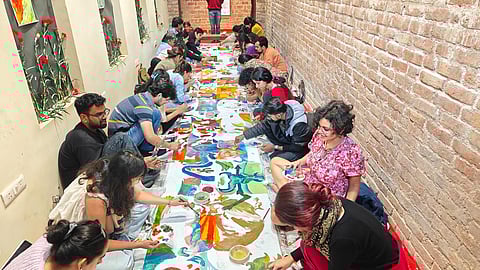
The Red House hall, adorned with 144 vivid red carnations, had transformed into a living studio where 28 artists of diverse abilities painted together on a monumental 30 ft × 3 ft canvas unfurled across the floor. Led by Arjun Shivaji Jain, director of Red House, the session emulated the raw, charged, and radically open terrain of Picasso’s own creative universe.
The collective painting experiment paid homage to the life, ferocity and tenderness of Pablo Picasso’s works.
Drawing from Picasso’s many periods and tumultuous biography, the workshop incorporated stream-of-consciousness techniques, encouraging participants to paint instinctively, intensely, and without inhibition, guided by the duende, the Spanish concept of earthiness, risk, passion, and emotional depth often associated with bullfighters and flamenco performers.
Yuvika Khanna and Anindya Ghose, two fine arts students, said that the workshop was more about community building and getting to know the artist through his art form. "It was not like any other session at school but an immersive experience," they said.
Rishabh, an entrepreneur who claims to have touched the painting brush for the third time in his life, said that although he was nervous sitting beside a fine arts student in the workshop, the intuitive experience encouraged his best strokes.
Picasso is one of the most celebrated artists on the global stage who is credited for transforming the language of art in the 20th century. This initiative of Red House “transformed the way art is perceived” said a participant. The workshop wasn't “technical” or about painting per se, but about the process to discover a space to express oneself.
With Spanish music in the hall, the workshop stepped into Picasso’s creative world, exploring the places and spaces where his iconic art took shape. It traced the artist’s diverse phases, styles, and passions, with about 20 people sitting together painting the same canvas. WHICH ONE?
Picasso used colour as an expressive element but relied on drawing rather than subtleties of colour to create form and space. An attendee leaving with hands full of colour said that even though she had known about Picasso since childhood, she experienced his art truly in the workshop. "I painted with pencils, colours in hand, brushes… and more than art, it was a community coming together to celebrate an artist," she said.