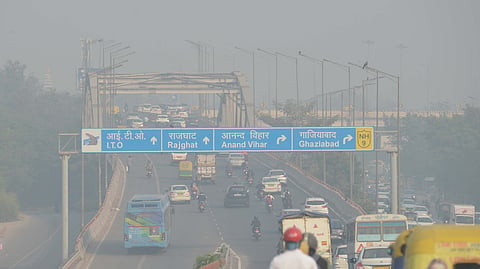

NEW DELHI: Air quality across the National Capital Region (NCR) deteriorated sharply in October, with the latest analysis by the Centre for Research on Energy and Clean Air (CREA) showing that all 10 of India’s most polluted cities were located within the region.
Dharuhera in Haryana topped the list with a monthly average PM2.5 concentration of 123 µg/m³, followed by Rohtak, Ghaziabad, Noida, Ballabgarh, Delhi, Bhiwadi, Greater Noida, Hapur, and Gurgaon.
Delhi ranked sixth, recording an average PM2.5 level of 107 µg/m³—nearly three times higher than the 36 µg/m³ logged in September. According to CREA’s analysis, the capital breached the National Ambient Air Quality Standards (NAAQS) on most days, registering 13 “very poor” and four “poor” air quality days during the month.
Despite stubble burning contributing less than six per cent of Delhi’s PM2.5 levels, pollution soared, underscoring the role of local and year-round emission sources such as vehicular traffic, construction dust, and industrial activities.
Manoj Kumar, analyst at CREA, said, “Winter and festive periods don’t create India’s pollution problem, they expose it. These seasonal spikes merely amplify baseline pollution levels that remain dangerously high throughout the year.”

He added that reactive, short-term measures like the Graded Response Action Plan are inadequate without sector-specific emission cuts backed by accountability. Overall, air quality worsened across the Indo-Gangetic Plain, with a significant shift in cities moving into higher pollution categories.
In October, the number of cities with “good” air (0–30 µg/m³) dropped from 179 in September to 68, while those with “moderate” and “poor” air rose sharply. Haryana and Uttar Pradesh each contributed four cities to the top ten list, reflecting NCR’s continued dominance in India’s pollution rankings.
In contrast, southern and northeastern cities fared far better. Shillong in Meghalaya emerged as the cleanest city in October with an average PM2.5 level of 10 µg/m³, followed by several cities in Karnataka and Tamil Nadu that consistently remained within national air quality standards.
Delhi’s air quality improved this year: Sirsa
The Delhi government on Tuesday claimed that the city’s air quality has shown significant improvement this year, with an AQI of 291 recorded on November 4, the best for this date in the last seven years.
Delhi Environment Minister Manjinder Singh Sirsa said the city’s AQI figures for the same date in previous years were 381 in 2024, 415 in 2023, 447 in 2022, 382 in 2021, 343 in 2020 and 407 in 2019.
“Deployment of 390 anti-smog guns, 280 water sprinklers and 76 mechanical sweepers across pollution hotspots contributed to this improvement. Regular vehicular checks are also being carried out,” Sirsa said.