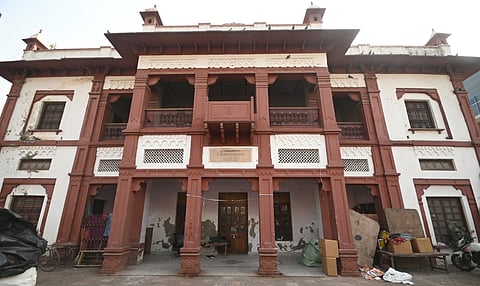

Old Delhi has never been short of stories. They spill out of its narrow lanes, hide behind fading façades and linger in the courtyards of ageing havelis. Soon, one of its architectural landmarks will have a new role in preserving these memories. The nearly century-old Lahori Gate Haveli is set to become a museum dedicated to the history and cultural legacy of Shahjahanabad.
Situated at Vasudev Captain Chowk, at the bustling intersection of Khari Baoli and Naya Bazaar, the haveli occupies a fascinating corner of the Walled City. Outside, spice merchants haggle, handcarts negotiate narrow passages and the air carries the mingled aromas of cardamom, dried chillies and freshly ground spices. Against this animated backdrop stands the restored two-storey structure, a reminder of a time when havelis were expressions of a city's social and architectural identity.
Built in 1929 as a private mansion, the haveli has had several avatars. It became a municipal dispensary, serving the neighbourhood until 2003, before being used as a storage space by merchants from the surrounding spice market. A proposed museum initiative in 2004 failed to take off, and the building gradually slipped into neglect, its balconies and architectural details bearing the scars of time.
For old residents, the building is more than an architectural landmark. "The haveli has been part of our neighbourhood for as long as I can remember. There was a time when people came here for treatment at the dispensary. Later, it just stood neglected. It is good to see the building restored. I hope it becomes a place people visit again and remains connected to the neighbourhood," says Ramesh Chand Gupta, a long-time resident of the area.
After years of delays, restoration work was completed in 2025, bringing the structure back to life. Now, the Municipal Corporation of Delhi (MCD) has partnered with the Indira Gandhi National Centre for the Arts (IGNCA) to transform it into the Shahjahanabad Museum and Interpretation Centre. Under an agreement signed in October 2026, MCD will provide the premises, while IGNCA will conceptualise the galleries, select artefacts and manage the museum for an initial period of five years. The facility is expected to become operational within six months.
The idea is to create more than a conventional museum. Visitors will be taken through the many layers of Shahjahanabad, exploring its architecture, urban evolution, religious diversity, markets, crafts and everyday customs. Proposed displays will feature representations of landmarks such as the Red Fort, Jama Masjid and Town Hall, alongside traditional havelis and places of worship belonging to different communities.
The galleries will also explore the city's trading networks, from its kirana and dry-fruit markets to its handicrafts and the legendary Meena Bazaar. Archival photographs, artefacts, interactive maps, audio-visual presentations and digital reconstructions are expected to bring these histories alive.
For those who have spent generations doing business in these lanes, the initiative could offer a much-needed perspective on a city often reduced to its food and shopping trails. "People come to Old Delhi for its food and shopping, but there is so much more to this place. Every lane has a history and every old building has a story. A museum like this could help visitors understand the city beyond its crowded markets and monuments. It is important that our heritage is preserved for the next generation," says Mohammad Salim, a second-generation masala shopkeeper in Khari Baoli.
What makes the initiative particularly interesting is its emphasis on everyday life. Shahjahanabad's history belongs as much to its generations of traders and craftsmen as it does to its grand monuments. It lives in the Urdu poetry associated with its streets, the skills passed down through families and the traditions that continue to shape its neighbourhoods. Capturing these details could offer visitors a more intimate understanding of Old Delhi.
The first floor is also expected to house audio-visual facilities and a gathering space, while a cafeteria and souvenir shop will add to the visitor experience.
There is something fitting about the choice of location. Amid the commercial frenzy of Khari Baoli and Naya Bazaar, where centuries-old trading traditions coexist with the demands of a modern marketplace, the haveli offers a moment to pause. Its transformation also underlines the importance of adaptive reuse in preserving historic buildings that might otherwise fade into obscurity.
When its doors finally open, the Lahori Gate Haveli could become more than another tourist attraction. It could offer a window into the many lives of Shahjahanabad, allowing a city that has always worn its history on its sleeve to tell its own story.
