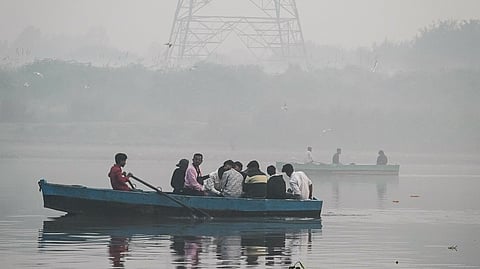

Delhi's air quality remained in the 'very poor' category on Thursday morning, with the overall Air Quality Index (AQI) recorded at 321 at 7 am, according to the Central Pollution Control Board (CPCB). A thick layer of smog continued to blanket several parts of the capital, reducing visibility during the early morning hours.
PM2.5 and PM10 remained the major pollutants across the city, CPCB data showed. Among the monitoring stations, NSUT Jaffarpur recorded the highest AQI at 399, followed by Chandni Chowk (387), Pusa (IITM) (386), NSIT Dwarka (383) and JNU (378). Punjabi Bagh recorded 371, while Chhawla registered 368 and CRRI Mathura Road 365.
Aya Nagar recorded an AQI of 363, Talkatora Garden 362, Commonwealth Sports Complex 352 and Sirifort 347. Ghummanhera registered 331, followed by Tikri Kalan (320), Shadipur (316), Burari (314), Uttam Nagar (309) and Jharoda Kalan (304).
Other monitoring stations recorded lower readings, with Maidan Garhi and Mandir Marg at 289 each, Pusa (DPCC) at 269 and Karala at 256. No readings were available for Lodhi Road and Badarpur.
The capital's air quality has remained under pressure since Diwali celebrations on November 8. Residents woke up to thick smog on Monday, with several monitoring stations recording AQI levels above 400 in the 'severe' category. Visibility was also reduced during the early morning hours.
The pollution has been compounded by falling temperatures and moderate fog. The Delhi government has deployed water sprinklers across the city as part of its efforts to control particulate matter.
On Wednesday, a delegation of the Aam Aadmi Party met the Member Secretary and Members (Technical) of the Commission for Air Quality Management (CAQM) at its office and raised concerns over air pollution in the capital.
The meeting came after the CAQM invoked Stage III of the Graded Response Action Plan (GRAP) across Delhi-NCR on November 6, ahead of Diwali, amid forecasts of worsening air quality.
Stage III measures operate alongside restrictions under the earlier stages and include additional pollution-control measures and enforcement by agencies across Delhi and adjoining districts of Haryana, Uttar Pradesh and Rajasthan. The emergency plan is activated based on pollution and weather forecasts issued by the India Meteorological Department and the Indian Institute of Tropical Meteorology, allowing authorities to act before the citywide AQI reaches the 'severe' category.
GRAP is a four-stage emergency framework implemented by the CAQM in coordination with the CPCB and state governments. Restrictions become progressively stricter as air quality deteriorates.
Meanwhile, Mumbai recorded an AQI of 146 in the 'moderate' category at 7.10 am, according to CPCB data. Bandra Reclamation registered 199.
Across Maharashtra, Bhiwandi recorded the highest AQI at 221, followed by Malegaon at 208, both in the 'poor' category. Pimpri-Chinchwad recorded 182, Sangli 180, Parbhani 177, Jalgaon 165, Nanded 163 and Chandrapur 162.
Nashik recorded an AQI of 152, Belapur 150, Mahad 149, Thane 146, Dombivli 144, Navi Mumbai 140, Ambernath 139, Dhule 138, Jalna 134, Mira-Bhayandar and Ahmednagar 118 each, Virar 118, Vasai 113, Ulhasnagar 111, Akola 108, Kolhapur 103, Kalyan 101 and Amravati 100.
Solapur recorded 97, Satara 95, Aurangabad and Badlapur 90 each, Latur 90, Boisar 88, Beed 83 and Hingoli 62.
Under CPCB's classification, an AQI of 0-50 is 'good', 51-100 'satisfactory', 101-200 'moderate', 201-300 'poor', 301-400 'very poor' and 401-500 'severe'.
(With inputs from ANI)
