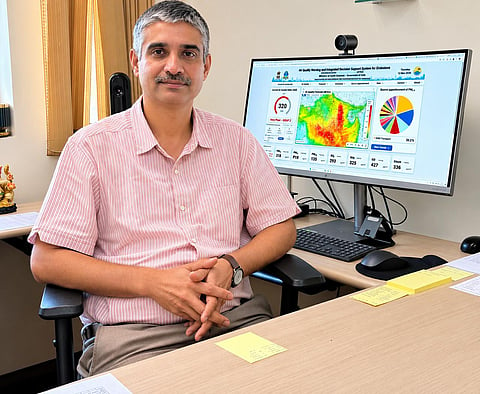

Every winter, Delhiites wake up to a familiar sight: a grey city, disappearing buildings, hazy roads and an AQI that seems to climb faster than the morning sun. But how much of that blanket is fog and how much is pollution? For Dr Sachin Dinkar Ghude, a scientist at the Indian Institute of Tropical Meteorology (IITM), Pune, finding the answer has become a significant part of his work.
The connection first caught his attention in 2015, when he was tasked with developing an early warning system for winter fog to support aviation operations at Delhi's Indira Gandhi International Airport. His investigation revealed that fog and pollution were closely intertwined. “Fog is not isolated. There is a strong coupling between pollution and fog. Sometimes we also get confused whether it is haze, smog or fog,” he says. What began as a fog-monitoring exercise eventually evolved into an air-quality forecasting system capable of predicting pollution levels up to 72 hours ahead, helping authorities prepare for severe episodes rather than simply react to them.

Ghude's journey into atmospheric science began in Antarctica in 2002. Trained in electronics and instrumentation, he joined an Indian expedition to measure greenhouse gases at the Maitri research station. An unusual observation of the ozone hole, which he initially suspected was an instrument error, sparked his interest in atmospheric chemistry. A subsequent fellowship at the National Centre for Atmospheric Research (NCAR), US, equipped him with expertise in chemical transport and air-quality modelling.
Adapting these models to Delhi's pollution levels was another challenge. “The model was not tuned for Indian conditions,” he says, pointing to the country's significantly higher PM2.5 concentrations. An initial prototype developed in 2018 struggled to predict severe pollution episodes accurately. The team therefore integrated real-time readings from monitoring stations into the model. “We cannot run the model in a silo. We need to have this model talk to observations also,” says Ghude.
The forecasting system was eventually refined to operate at a resolution of 400 metres across Delhi-NCR. But knowing how polluted the air was only answered half the question. Authorities also needed to identify the sources: vehicular emissions, construction dust, stubble burning or pollution transported from neighbouring regions. “The next question was where the pollution was coming from,” he explains.
This led to a source-tracking model that identifies emission hotspots and geographical contributors. Integrated into the Decision Support System (DSS), it draws on monitoring-station readings, satellite observations, weather data and stubble-burning information to estimate pollution sources and forecast air quality.
The findings are shared with the India Meteorological Department (IMD) and subsequently with the Commission for Air Quality Management (CAQM), helping authorities decide when restrictions under the Graded Response Action Plan (GRAP) need to be introduced or intensified. The DSS also allows officials to test possible interventions. Simulations examining a 20 or 40 per cent reduction in vehicles, or diverting five to seven million tonnes of crop residue from open burning to controlled industrial use, indicated the potential for a 40–50-point improvement in AQI.
The work is now extending to Mumbai, while Delhiites can access real-time readings, three-day forecasts and health advisories through the Airwise app. The team is also exploring artificial intelligence alongside conventional modelling to improve predictions during extremely severe pollution episodes. For Ghude, the real achievement is seeing scientific forecasts translate into government action. “Somebody is doing the forecast, other agencies are using that forecast in real time, and then a third agency is implementing it. That circle is actually completed,” he says.
For a city that spends several months every year looking at the world through a grey veil, knowing what is in the air, where it comes from and what might improve it could make all the difference.