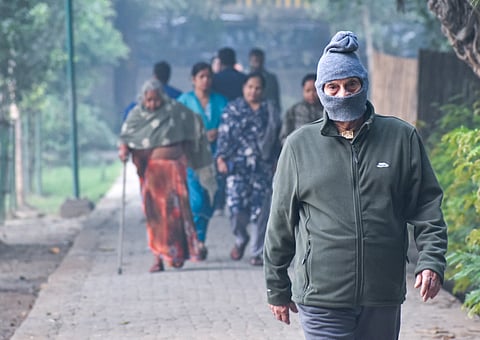

Delhi’s air quality deteriorated to hazardous levels on Friday morning, with the overall Air Quality Index (AQI) touching 494 at 7.31 am. Dense fog and pollution enveloped the national capital, reducing visibility across several areas, while multiple monitoring stations recorded severe pollution levels.
According to Central Pollution Control Board (CPCB) data, IIT Delhi recorded an AQI of 488, followed by ITO at 455, Anand Vihar at 419, Rohini at 413 and Rajokri Border at 402, all falling in the severe category.
Other areas also reported very poor air quality, with R K Puram recording an AQI of 391, Mandir Marg 378, Dwarka Expressway 369, Uttam Nagar 363 and Lodhi Road 341. The area around Dhaula Kuan recorded an AQI of 161, placing it in the moderate category.
The Delhi government has been undertaking pollution-control measures, including deploying water sprinklers across the city, to minimise the impact of particulate matter.
Meanwhile, AAP leader Saurabh Bharadwaj on Thursday accused the BJP government of misrepresenting Delhi’s pollution levels and questioned the credibility of the CPCB’s AQI readings. Citing a report by the Centre for Research on Energy and Clean Air (CREA), he alleged that actual pollution levels were 49 per cent higher than those displayed on official government websites.

Speaking to ANI, Bharadwaj claimed that an AQI reading of 370 could have corresponded to an actual level of 560 or higher.
“CREA showed that the pollution shown for Delhi was 49% higher than what you were told—meaning it was almost one and a half times higher,” he said.
Bharadwaj also questioned the CPCB’s explanation on the limits of its monitoring system, alleging that readings exceeding 999 were not displayed.
“The CPCB said that when our pollution level hits 999, we don't even consider that level, because we can't measure above 999 and we don't display 999. So it's just shown as zero,” he told ANI.
He alleged that the discrepancy amounted to a fraud against Delhi’s two crore residents, saying it put the health of children and elderly people at risk.
The allegations followed a CREA analysis of hourly PM2.5 data from 59 monitoring stations in Delhi. The report identified 255 missing hourly station records between 4 pm on November 8 and 4 pm on November 9. It also recorded a rise in the 24-hour average PM2.5 concentration from 269 to 400 micrograms per cubic metre, an increase of nearly 49 per cent.
(With inputs from ANI)