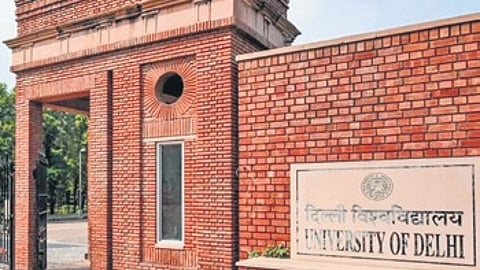

NEW DELHI: Despite provisions for reservation in place, students from the Scheduled Tribe (ST) and Scheduled Caste (SC) communities continue to remain under-represented in several segments of the University of Delhi (DU), with the varsity’s annual report revealing that ST students account for just 3.8% of regular undergraduate (UG) enrolment, against the prescribed reservation benchmark of 7.5%.
The figures, published in DU’s 103rd annual report for 2025–26, showed that the representation of Other Backward Classes (OBC) students also remains below the 27% reservation benchmark across undergraduate, postgraduate (PG) and research programmes.
The report, tabled at the executive council meet on Thursday, presented a breakdown of SC, ST and OBC student enrolment across levels of education and modes of study, raising questions about the reach of affirmative action.
The disparity shown in the data is particularly stark for ST students. Their share stands at just 1.8% of total UG enrolment across all modes, rising to 3.8% among regular students. At the PG level, the representation stands at 4.3% across modes and 5.6% in regular programmes. Among PhD scholars, it is 6%.
SC representation falls short of the 15% benchmark in several categories. While SC students account for 15.3% of undergraduate enrolment across all modes, their share drops to 13.9% in regular UG programmes. At the PG level, it stands at 12.3% across modes and 13% among regular students. Among research scholars, SC representation is 14%.
OBC enrolment remains below the 27% benchmark at every level. OBC students account for 15.5% of total UG enrolment across modes and 23.5% in regular programmes. At the PG level, their share is 20.2% across modes and 24.1% in regular courses. Among PhD scholars, it stands at 24.6%.
Varsity reports Rs 82-cr surplus
DU has moved from a deficit of Rs 65.96 crore in 2024–25 to a surplus of Rs 82.44 crore in 2025–26. However, the improved financial position has done little to allay concerns among teachers over the university’s growing dependence on loans from the Higher Education Financing Agency
