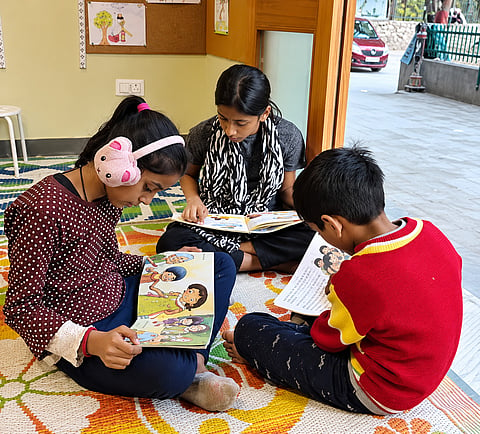

Every evening, children drift into a community library in Delhi’s Mehrauli, drawn by shelves lined with books and the freedom to read whatever catches their eye. Some come to borrow books, others settle down for a story, while a few simply browse until something holds their attention. There is no prescribed reading list, membership fee or pressure to read at someone else's pace.
Founded in 2022 by British author Orlanda Ruthven, a Mehrauli resident of nearly two decades, the Mehrauli Community Library began as an effort to bridge learning gaps among children following the Covid-19 pandemic. Today, it has over 6,000 books and more than 2,200 registered student members.
Sixteen-year-old Dalbeer has been visiting since its inception. For him, the library offers something his school library doesn't: books that invite rather than intimidate. “It has become a place where I can read at my own pace,” he says. Fond of history, poetry and illustrated books, he finds the collection easier to engage with. “The school library has very thick books. I don't feel like reading them because they don't have any pictures. Here, the books have small stories with pictures. It tells or explains more about the story.”

Run by volunteers and part of the Free Library Project, the library houses picture books, children's literature, fiction, non-fiction and school textbooks. Membership and borrowing are free, and anyone can walk in.
Building the library involved starting small. “We started working on this from ground level. Earlier, the library was not there. We used to go to a nearby community and do read-aloud sessions there with members. We first carried some books there, then searched for a space and prepared it to build the library,” says Mahima Kumari, who has been associated with the initiative since its inception. The aim was to introduce children to books beyond their school curriculum while helping those who had fallen behind academically.
The collection continues to grow through donations and regular additions. Picture books from publishers such as Usborne and Pratham are popular with younger readers, while children increasingly ask for titles of their own choice. “Children often request horror stories, while adult members have asked for more poetry and self-help books,” says Kumari.
Drawing members from neighbouring colonies such as Islam Colony and Ghosha, the library caters largely to children aged 11 to 16. It also welcomes school dropouts, recent migrants and children unable to attend school because of financial or other difficulties.
Beyond lending books, the library holds daily read-aloud sessions, Hindi reading fluency classes and a book club twice a week. Children read together, discuss stories and identify their central ideas. “Reading is not just mere reading. It is also about thinking. If one can't understand then it has no meaning,” says Kumari. “We are trying to inculcate this.”
Children also help run the space through a student leader programme, learning to use computers, catalogue books and organise shelves. They welcome newcomers, recommend titles and take responsibility for keeping the library in order. Volunteers assist with the collection and help children with subjects such as mathematics, science and computers. “It is their responsibility as well,” says Kumari, referring to how regular members step in to put back misplaced books.
With 30-40 visitors on weekdays and 50-60 over weekends, the library has become a neighbourhood resource. Joining requires only a basic membership form; no fees or identity documents are needed. Its open shelves are central to its philosophy, allowing children to browse freely and discover books beyond their usual interests. “Members will only discover their interest only when they see the books themselves,” says Kumari.
Here, a child can walk in looking for a story and leave with a book of poetry, history or something entirely unexpected. The choice, quite simply, is theirs.