
Delhi winters have a familiar morning ritual: waking up to a grey sky, checking the AQI and stepping out into air thick with smog. For schoolchildren, it often means persistent coughing, breathing difficulties and, at times, weeks of disrupted classes.
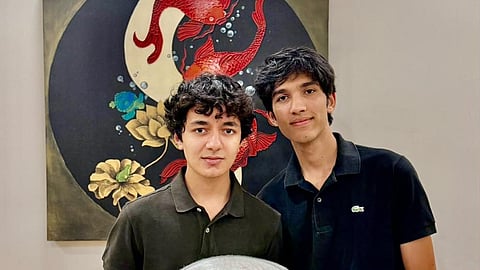
While air purifiers offer some relief, their high cost puts them beyond the reach of many schools and low-income households. Krish Aggarwal, 17, believes the answer could lie in something every classroom already has: a fan. Along with his cousins, Samarth Meattle and Savya Miyashil, he started Project Vayu, an initiative that converts ordinary table and wall fans into low-cost air purifiers. The project has reached 10 schools and two medical centres and won the Diana Award 2026.
For Krish, the cause is personal. Having experienced breathing difficulties himself, he found relief with an air purifier at home. But he soon realised that most families could not afford one, leaving children from economically weaker communities particularly vulnerable. “Schools during winters shut down for two to three weeks because of pollution; students face breathing problems. So we decided to do something about it,” he says.
The idea took shape in 2023, when Krish was in Class 9. Rather than build expensive purifiers from scratch, the cousins developed filters that could be fitted around existing fans. After testing five to six materials for filtration efficiency and airflow, they settled on electrostatic filter media, similar to that used in N95 masks.
Tests showed a 50-60 per cent reduction in PM2.5 levels in a typical classroom within an hour. The filters need replacing every month or six weeks during winter. “We ask the school to replace them every month or six weeks during the winter pollution season, when they turn visibly black with accumulated particles,” Krish says.
Getting schools on board was not easy. The cousins often struggled to be taken seriously because of their age. “We had to follow up 10-15 times just to get schools to look at our project and implement it. People saw it more as a school project than something that could actually work,” he says. The NGO Mobius Foundation helped introduce Project Vayu in its first three schools, reaching an estimated 8,000-9,000 students.
The initiative is supported by family contributions and corporate assistance. Hollingsworth & Vose, a multinational filtration-media manufacturer, supplies the filter material free of cost and helps with research and development. Each filter costs around Rs 30-50 to manufacture, an expense currently borne by the cousins' parents. “We are fortunate enough to be able to afford the manufacturing cost ourselves. We don't really plan to make a profit off it in the near future. We just want to do good for everyone,” Krish says.
The cousins juggle the initiative with schoolwork, sharing responsibilities according to their academic schedules. “If I have an exam, for instance, my younger cousin takes on most of the work. It really depends on our schedules. We do everything together,” he says.
Their next target is to reach 40-50 schools in Delhi this year before expanding to other parts of the country. Krish is not yet thinking of turning Project Vayu into a career. For now, his ambition is straightforward: to make clean air more accessible to children, one classroom fan at a time.
