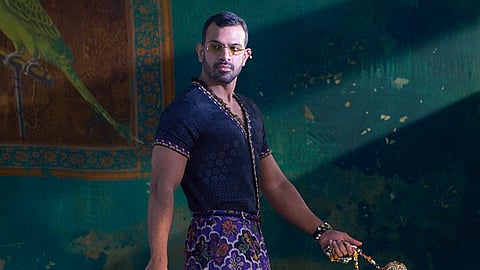

For Delhi-based designer Karan Torani, fashion begins not on a runway but in the rooms of an Indian home, among inherited clothes, family histories and memories of a homeland left behind. In 2018, Torani started his label in his living room with four karigars. With no family background in fashion and little experience of running a business, he drew inspiration from his nani’s wardrobe, the histories of Sindh and Punjab, and the colours and drama of Indian weddings.
Nearly eight years later, his creations have found a place in some of the country's most high-profile celebrations. Deepika Padukone wore his signature saris during Anant Ambani and Radhika Merchant’s wedding festivities, while Isha Ambani appeared in his multicoloured Dilruba lehenga. More recently, Priyanka Chopra Jonas wore a custom red Diwali gown created in collaboration with stylist Ami Patel.
Yet Torani’s first indication that his stories were resonating came through handwritten letters. When he began exploring Partition, Sindh, Punjab and old Lahore through his collections, Sindhi families across the world reached out. “I’d started with memories that felt very particular to my own family, and here were people I’d never met recognising something of theirs in them,” he recalls.
Celebrity visibility subsequently introduced the label to a wider audience. But the Priyanka Chopra Jonas collaboration tested its creative and operational capabilities in a different way. With just five days to deliver the Diwali gown to Los Angeles, the team divided its embroidery into panels, allowing multiple artisans to work simultaneously. The result involved more than 2,200 hours of craftsmanship, combining Kashmiri aari, zardozi, mirrors and cowries. Inspired by a bird perched in a jharokha, the deep-red creation celebrated Lakshmi and the abundance associated with Diwali.
Torani’s ambitions now extend beyond clothing. Collaborations with Swadesh and myTrident have opened up possibilities in other lifestyle categories, while jewellery, fragrance, films and home furnishings remain on his wishlist. He also dreams of creating an entire wedding experience, an idea rooted in childhood memories of his father’s business, Sindhi Tent House, which organised elaborate weddings in the 1980s.
His own journey into fashion began at Pearl Academy, followed by stints with designers Nida Mahmood and Manish Arora. Their contrasting creative approaches helped him understand how imagination could translate into fashion. But his strongest inspiration remained closer to home. “I used to feel there was a certain embarrassment about claiming an ordinary middle-class Indian home as a source of beauty. For me, those were the rooms I most wanted to go back into.”
That philosophy continues to inform the label's storytelling, including Torani Talkies, a series exploring motherland, making and memories.
Looking ahead, he hopes to build an internationally recognised Indian luxury house. But his most significant ambition is perhaps a number: 5,000. That is how many families he eventually hopes the business will support through sustainable livelihoods.
For Torani, success is not merely about global recognition. It is about building a business that safeguards India's craft traditions, creates opportunities for its artisans and remains rooted in the memories that inspired it all. As he puts it, he wants young designers to remember him as someone who took his work seriously, looked after his people and “still made it home for dinner”.
