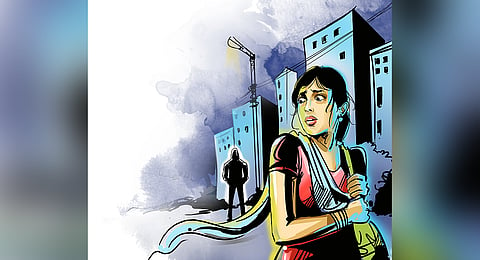

For many women and girls in Delhi, the journey to a metro station or bus stop is a source of fear, with nearly nine in 10 feeling unsafe making their way to the nearest public transport stop, a study by a gender equality organisation has found.
The study, conducted by the Centre for Equity and Inclusion (CEQUIN), found that 87.5 per cent of those surveyed felt unsafe walking to the nearest metro station or bus stop, while 88.9 per cent felt unsafe in their nearest public park after dark. More than three-fourths reported poorly lit footpaths, and 60 per cent said the footpaths were broken or missing.
The study was released on Wednesday at CEQUIN's annual event, 'Hain Haq Hamara Hissedari', held at Vasant Udyaan in Vasant Vihar, marking the start of the '16 Days of Activism' against gender-based violence.
According to a statement by CEQUIN, the findings, based on responses from 1,588 women, girls and LGBTQ+ people, point to a safety concern that extends beyond the threat of sexual violence -- to the conditions in which people navigate the city every day.
For nearly 80 per cent of those surveyed, men's behaviour -- including staring, passing comments and following them -- made everyday journeys unsafe.
The study also found that 80.5 per cent could not identify the civic authority responsible for addressing their concerns, while 52.3 per cent did not know where to complain about problems related to footpaths and public parks.
The lack of awareness was particularly pronounced among senior citizens, with 80.6 per cent of respondents aged 60 and above saying they did not know where to complain. Even among those living in planned colonies, DDA flats and housing societies, 62.9 per cent did not know where to report civic problems.
Among respondents who knew where to complain, only 29 per cent were aware of the MCD's 311 grievance-redressal platform, highlighting the gap in awareness of municipal complaint mechanisms.
The study, titled 'Everyday Journeys: Women's and Girls' Access to Footpaths and Public Parks in Delhi', examines how infrastructure, social behaviour and institutional failures shape women's access to public spaces.
CEQUIN, which works on gender-based violence and women's rights, has submitted its recommendations to the Supreme Court, the statement read.
The findings come against the backdrop of a spate of rape and sexual assault cases reported across Delhi-NCR, including the alleged gangrape of a 17-year-old girl at Aastha Kunj Park.
At least 13 such cases were reported in the first three weeks of September, prompting the Supreme Court to take suo motu cognisance on September 28 and direct authorities to identify vulnerable public spaces and strengthen safety measures.
According to the statement, the study was undertaken in response to this intervention and draws on CEQUIN's 17 years of work on gender-based violence and women's rights.
It looks beyond individual crimes to examine how the design and upkeep of public spaces, along with social behaviour and gaps in institutional accountability, can limit women's ability to move freely.
"When over 80 per cent of respondents cannot even identify which civic authority is responsible for addressing these gaps, exclusion becomes built into the city itself," Lora K Prabhu, co-founder and managing director of CEQUIN, said, adding that the organisation hoped its recommendations would drive measurable, gender-responsive urban reform.
Prabhu said safety measures should focus on enabling women to access public spaces rather than restricting their movement following incidents of sexual violence.
She said the response to such cases often involved withdrawing women from public spaces instead of making those spaces safer.
She also emphasised that policing alone could not ensure women's safety, observing that police measures were often responsive rather than preventive.
One of the key findings the organisation highlighted was that women generally felt safer in a public space when at least one-third of the people present there were women, underscoring the importance of women's presence in streets and parks.
The report also cites National Crime Records Bureau data, which showed that Delhi recorded 13,396 crimes against women in 2024, the highest among India's 19 major metropolitan cities.
It further points to the disparity in workforce participation, with Delhi's female Labour Force Participation Rate at 14.5 per cent in 2023-24, compared with 54 per cent for men.
The report argues that safety fears and restricted mobility affect women's access to employment, though the figures do not establish a direct causal relationship.
The corresponding national female labour force participation rate was 41.7 per cent, according to the Delhi government's statistics cited in the report.
Founded in 2009, CEQUIN works across Delhi-NCR, Haryana, Rajasthan and Bihar to prevent and address gender-based violence through community mobilisation, advocacy and institutional engagement, with a focus on women, adolescent girls and gender-diverse people from marginalised communities.
(With inputs from PTI)
