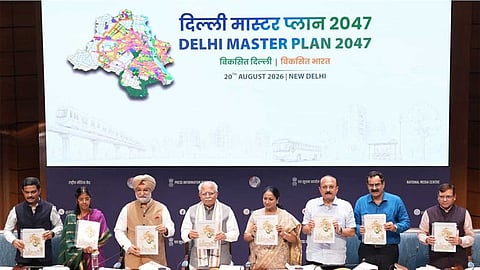

In these columns we have been discussing the fallout of a good policy badly implemented. The immediate reference was the notification of the Master Plan for Delhi 2047, and the larger question was whether Delhi had learnt from the experience of its previous master plans. We had also argued that, ironically, some of the city’s most enduring infrastructure has come not from the master plans themselves but from the legacy projects associated with major events.
Delhi’s experience with the Commonwealth Games is a case in point. The Games were controversial but it cannot be denied that the infrastructure created around them continues to sustain the city. Roads, flyovers, bridges, Metro extensions, public spaces and other connectivity projects became part of Delhi’s permanent physical infrastructure.
However, the fate of two delayed Commonwealth Games-era projects, Barapullah III and the Bhairon Marg underpass, offers an important lesson for the government now attempting to push delayed infrastructure back onto the fast track. A delayed infrastructure project is not merely a project whose completion date has been pushed forward, it’s to be remembered that lapse of time changes the city around the project.
A project designed to solve the traffic problem of 2010 cannot automatically be assumed to be the ideal solution to the traffic problem of 2026. This is precisely where the Barapullah III and Bhairon Marg experiences become instructive.
The momentum behind several infrastructure projects weakened after the Commonwealth Games, particularly after the change of government in Delhi. Political priorities shifted. Infrastructure development gradually took a back seat to welfare-oriented politics, or what has increasingly become a rather sober synonym for the politics of freebies. Projects that required sustained administrative attention and significant capital expenditure did not enjoy the same political urgency.
There was nothing inherently wrong with welfare spending. The problem was the false choice that Delhi’s politics eventually created between welfare and infrastructure. A city cannot remain functional merely by distributing benefits to
its residents. It has to build and maintain the physical systems through which those residents travel, work, study and conduct their daily lives.
The BJP government that now runs Delhi appears determined to reverse that approach and put infrastructure projects back on the fast track. That is welcome but there is a danger in treating every inherited project as if its only problem were administrative delay. The Barapullah III experience should serve as a warning.
When a project finally emerges after years of delay, the temptation is to celebrate its completion. There are ceremonies, speeches, photographs and political credit-taking. But for the citizen, none of that matters if the project does not deliver the promised improvement in mobility.
Indeed, an ostentatious inauguration can become counterproductive. If a project opened with great fanfare immediately creates new bottlenecks, complicates existing traffic flows or merely transfers congestion from one point to another, the ceremony becomes a reminder of governmental insensitivity rather than an occasion for public appreciation.
Urban infrastructure has to be treated as a network, not as a collection of independent engineering projects. This is particularly important when projects have been delayed for a decade or more.
Every delayed project should come with a fresh traffic assessment, a revised cost-benefit analysis and a plan for the surrounding network. Every inauguration should follow, rather than precede, evidence that the project will actually improve mobility.
Delhi has waited long enough for some of these projects. It should not have to wait again to discover that completing an old project has created a new problem. The government in office will inevitably seek political credit for the infrastructure it delivers. That is part of democratic politics.
However, the best political credit is still the most old-fashioned kind that is a citizen reaching home faster, a bus moving smoothly, a road becoming safer and a traffic jam disappearing. For Delhi, that would be an inauguration worth celebrating.
Sidharth Mishra
Author and president, Centre for Reforms, Development & Justice
