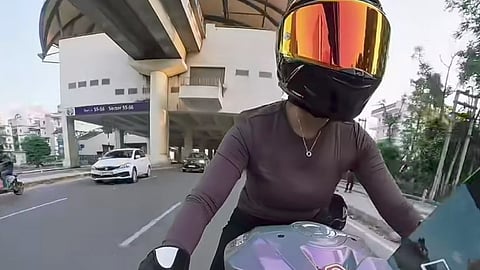

Last month, biker Shivani Chauhan was chased down allegedly in a case of road rage by car driver Kalyan Bainsla on Gurugram’s Golf Course Road. Amiyanshi Srivastava faced a similar incident. She recalls an evening on the Noida Expressway when a car full of men began tailing her Yamaha R15. The occupants repeatedly pulled alongside her, matched her speed and cut across her lane, forcing her to slow down.
The 22-year-old waited until she reached heavier traffic, manoeuvred between vehicles and pulled into a crowded petrol pump. “I did not want to engage in a high-speed chase on public roads,” she says. The encounter has shaped how she navigates the city. Now, she avoids riding late at night alone or travelling through isolated stretches, and prefers familiar, well-lit roads.
For women riding motorcycles and sports bikes across Delhi-NCR, such calculations have become part of an activity they otherwise associate with freedom and independence.

Under the gaze
“Riding in Delhi-NCR has been a mix of freedom and unsolicited attention,” says Akanksha Sharma, lead instructor with LetsRyde, who trains women motorcyclists in the region. Stares, comments and motorists deliberately blocking their way, she says, are familiar experiences. A woman on a powerful motorcycle is “a public spectacle”.
The difference in how men and women riders are perceived is particularly striking. “There’s this annoying stereotype that women who ride are either doing it purely for attention or that we are inherently reckless. Men are assumed to be enthusiasts by default. Women are assumed to be trying to prove something,” says Srivastava.
The attention is not always hostile. Fellow motorists, including men, sometimes offer encouragement, while children wave or give riders a thumbs-up. But curiosity can become intrusive when motorists try to race them, tease them or force their way into their lanes.
Sabia Khan, 43, a former IT professional and homemaker who took up riding recently, recalls a breakfast ride with around 10 to 12 women. Two men on a motorcycle repeatedly tried to enter the group’s lane and engage the riders in conversation, despite being asked to move away. The group’s marshals eventually intervened to get the men to leave.
Khan says women also encounter assumptions about their driving. At junctions, some motorists appear to expect them to give way even when they have the right of way. Such encounters, she says, can turn an ordinary journey into an exercise in managing other people’s behaviour.
Calculating the risk
Sharma recalls a confrontation during an early-morning ride from Noida to Gurugram, where she travels for training. A Thar approaching from the wrong side blocked her path. Its occupants refused to move, telling her to turn back and pointing out that she was a woman. “I did not say anything. I just went out of sight,” she recalls. She kept her helmet on and rode away when she could.
Such encounters illustrate the calculations women make when faced with aggressive motorists: whether to confront them, change course or head towards a crowded public place. The concern is not limited to those on motorcycles. Khan recalls driving through a relatively deserted stretch in Noida when two men on a motorcycle blocked her path. Although she managed to get past them, the incident left her worried for days. She even asked her husband to accompany her on subsequent journeys.
These experiences can influence when, where and with whom women travel. Group rides, location-sharing applications and motorcycle cameras offer some reassurance. Sharma says her riding groups use apps to track members’ locations and check when someone has stopped unexpectedly. Khan considers a camera an important investment, particularly after the attention generated by Chauhan’s incident highlighted the value of recorded footage.
But precautions cannot be the only answer. “The goal should not be to teach women how to ride around harassment. It should be to make harassment unacceptable on the road,” Sharma says.
More than a motorcycle
The challenges extend beyond harassment to assumptions about women’s ability to handle powerful motorcycles. Sharma rejects the notion that riding a sports bike is beyond women’s capabilities. “Riding is not a strength competition. It is about technique, control, practice and mindset,” she says.
For Iram Mirza, CEO of Firstborn Collective, the issue also lies in how the wider riding ecosystem accommodates women. She points to the limited availability of riding gear designed for women’s fit and the need for manufacturers and the industry to take female riders seriously.
Mirza argues that women on motorcycles continue to be treated as a novelty in a culture where men have long been the default image of a rider. Even attention intended as admiration can become uncomfortable when a woman’s presence on a motorcycle is treated as a spectacle.
“We don’t want that kind of attention. Why do you want to stare at us when we’re biking? Just treat it as normal,” she says. “Women should be able to ride because they enjoy it, not because their presence must be seen as unusual or inspirational.”
The right to ride
Making roads safer, riders say, requires more than asking women to travel in groups or avoid certain routes. Better enforcement against road harassment and road rage, safer and better-lit roads, greater awareness of traffic rules and accountability for motorists who intimidate others are all essential.
For these riders, motorcycling is not a statement about gender. Srivastava describes riding as a way to disconnect from stress. With her helmet on and the engine running, the surrounding noise seems to quieten. The concentration it demands gives her a sense of control over her own direction. For Khan, the appeal lies in the adrenaline and the feeling of being completely absorbed in the experience. For Mirza, riding offers a meditative space away from the roles society assigns women.
Sharma does not believe women should have to retreat from roads for safety. “I will never say that riders should sit at home. I don’t want women to stop riding because the roads can be difficult. I want the roads to become better,” she says.