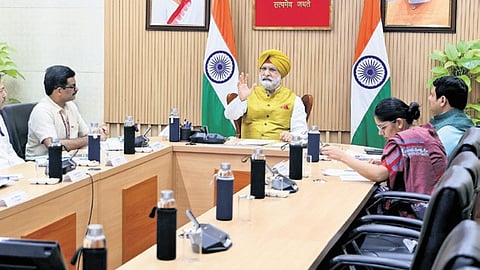

NEW DELHI: Lieutenant-Governor Taranjit Singh Sandhu on Wednesday reviewed the progress of the Delhi Development Authority’s Transit-Oriented Development policy with senior officials, stressing the need for sustainable infrastructure, better connectivity and timely execution of projects.
The policy, which allows high-rise development along Metro and rail corridors, is expected to boost housing supply under the proposed Master Plan for Delhi-2047. With the capital’s population projected to grow significantly by 2047, around 17 lakh dwelling units are envisaged under the TOD policy over the next 10 years.
“Delhi needs integrated, sustainable infrastructure that improves connectivity and quality of life. Reiterated the importance of delivering people-centric projects within defined timelines to build a future-ready ‘Viksit Dilli’,” Sandhu said in a post on X.
He emphasised faster execution, better coordination and strict adherence to construction milestones. In July, the DDA invited applications from developer entities under the policy.
The corridor-based approach covers 207 square kilometres, including areas within 500 metres on either side of Metro corridors and a 500-metre radius around Regional Rapid Transit System or railway stations, primarily to provide affordable housing. Residential high-rises within 250 metres on either side of Urban Extension
Road-II have also been included in the 2027 Master Plan to bridge the housing gap.
Meanwhile, the Delhi Development Authority held its ninth and tenth stakeholder consultations under MPD-2047, focusing on the proposed Education Hub and Medical Hub. The ninth consultation, attended by representatives of the Delhi government’s Education Department, schools, universities and other educational institutions, discussed plans for a 138-hectare Education Hub in Narela.
The hub is envisaged to accommodate universities, research institutions, vocational training facilities and start-ups to promote innovation, skilled employment and a knowledge-based economy. The plan also proposes enhanced Floor Area Ratio (FAR) for schools to support extracurricular infrastructure in line with the National Education Policy. It permits standalone schools and training facilities for children with disabilities and special needs, as well as residential schools.
The tenth consultation brought together healthcare institutions and representatives of the Health Departments of the Central and Delhi governments to discuss strengthening the capital’s healthcare network. The plan envisages an integrated network of hospitals, medical colleges, speciality facilities and wellness centres, alongside tertiary and super-speciality healthcare infrastructure to promote medical tourism. It also provides for specialised and long-term care facilities, including de-addiction and drug-rehabilitation centres, early intervention centres, transitional care homes and respite care centres.
