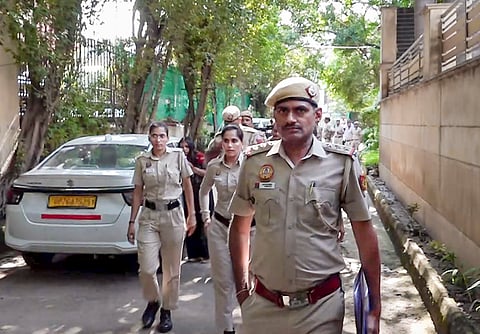

More than 20 Delhi Police personnel visited the residence of Cockroach Janta Party (CJP) founder Abhijeet Dipke and served him a notice prohibiting him from holding a protest at Connaught Place on Friday, hours before the scheduled march, citing risks to public safety, traffic disruption and stampede.
The CJP's 'Lehra Do Tiranga' march is scheduled to be held at Central Park in Connaught Place at 5 pm. Police have denied permission for the march, citing prohibitory orders under Section 163 of the Bharatiya Nagarik Suraksha Sanhita (BNSS), which bar mass gatherings in Connaught Place and adjoining areas. They have offered to facilitate a select group of protesters to wave the national flag at an alternative location.
The notice comes amid heightened security in the New Delhi area, with more than 6,000 police personnel and 220 companies of the Central Armed Police Forces (CAPF), each comprising 100 personnel, deployed to prevent any law and order situation.
The New Delhi Municipal Council (NDMC) has also announced that Central Park will remain closed to the public on Friday and Saturday for administrative reasons.
According to a copy of the notice accessed by news agency PTI, the Connaught Place station house officer issued it under the subject, “Regarding proposed unlawful assembly/demonstration at Connaught Place on October 16”.
The notice said it was issued in furtherance of directions of the Delhi High Court and referred to Dipke's public statements and social media calls asking people to assemble at Connaught Place at 5 pm without obtaining permission.
Describing Connaught Place as a busy commercial hub with concentric circles connected by radial roads and limited entry and exit points, the notice said a crowd gathering in one circle could obstruct adjoining areas, making dispersal and emergency evacuation difficult.
It said the area houses numerous showrooms, restaurants, hotels, banks, offices and street vendors, adding that any disruption during evening and weekend hours and the peak festival season would affect traders and their employees.
“Over 15 lakh traders and their employees depend on its peaceful and orderly functioning for the exercise of their fundamental right,” the notice said.
It also highlighted the presence of Rajiv Chowk Metro station, an interchange between the Blue and Yellow lines that caters to an average of two lakh commuters daily. A crowd build-up could cause severe congestion and pose a stampede risk, it said.
The notice further said that obstructing arterial roads passing through Connaught Place could disrupt traffic across central Delhi. It cited the area’s heavy vehicular and pedestrian movement and referred to the Delhi High Court's directions in Amit Saini v. Commissioner of Police, which require authorities to consider the inconvenience caused to commuters by public gatherings.
Connaught Place's proximity to Parliament, the Central Secretariat and diplomatic precincts also raised concerns about a possible spillover into protected zones, potentially jeopardising public order and safety, the notice said.
It added that older buildings and narrow service lanes restricted the movement of fire tenders and ambulances, while emergency vehicles serving nearby hospitals depended on clear routes.
The notice said a prohibitory order under Section 163 of the BNSS was in force and warned that any violation could invite action under Section 223 of the Bharatiya Nyaya Sanhita, which deals with disobedience to an order duly promulgated by a public servant, and other applicable provisions.
It also cited CJP's previous demonstrations, alleging that they had “resulted in breaches of peace and grave disruptions to public order” and that the party had violated conditions attached to earlier permissions.
“Their unauthorised calls for a march to the Parliament, which is a symbol of Indian sovereignty, resulted in serious violence and damage to public and private property,” the notice said.
Invoking Sections 29, 30, 31, 32 and 33 of the Delhi Police Act, 1978, among other provisions, the notice prohibited Dipke from holding any demonstration, procession or rally in the vicinity of Connaught Place. It also barred the carrying of instruments that could be used as weapons and the use of loudspeakers, among other activities.
The notice cited the Supreme Court's judgment in Mazdoor Kisan Shakti Sanghatan v. Union of India (AIR 2018 SC 3476), which highlighted the need for prior written permission for public demonstrations and the need to consider traffic obstruction, risks to human safety and disturbance to public tranquillity.
It said no permission had been sought for the proposed gathering and that Connaught Place was not a notified protest site. Other designated venues could be used subject to the requisite permission being sought and granted, it added.
Dipke was directed to comply with the law and refrain from actions that could affect the rights of traders, commuters, patients and other citizens, including their rights to livelihood, free movement and safety.
(With inputs from PTI)
